
Georgia Self-Storage Lien Law: The Operator's Guide to Risk-Free Enforcement
Here's a sobering statistic: 47% of self-storage operators have faced lien-related legal challenges, with average settlements reaching $8,500 per incident.
The culprit?
Not intentional violations, but simple administrative mistakes—wrong timing, incomplete notices, procedural shortcuts.
If you operate in Georgia, you have powerful lien enforcement rights that don't require a court order. But with great power comes great responsibility—and zero margin for error. Send your notice one day too early? Invalid. Forget to verify military status? Potentially catastrophic. Miss a required element in your advertisement? Start over.
The good news? Most mistakes are preventable. Let's walk through Georgia's lien law requirements so you can protect your revenue without risking your facility.
The Foundation: How Georgia's Lien Law Works
Georgia's Self-Service Storage Facility Act (O.C.G.A. §§ 10-4-210 through 10-4-218) gives you an automatic lien on all property stored in your facility the moment it enters your premises. No filing, no recording, no separate perfection process required.
Even better, your lien takes priority over almost everyone else—including banks, creditors, and other lienholders. The only exceptions are liens recorded before the tenant moved in, tax liens, and liens the tenant disclosed in writing.
This statutory lien secures more than just rent. You can recover:
Past-due rent (obviously)
Late payment fees (added in 2019)
Labor charges for handling property
Preservation expenses
All reasonable costs of the lien process itself
Important: The July 2024 amendments added new provisions for electronic rental agreements and streamlined procedures for unsigned agreements. Make sure your forms are current.
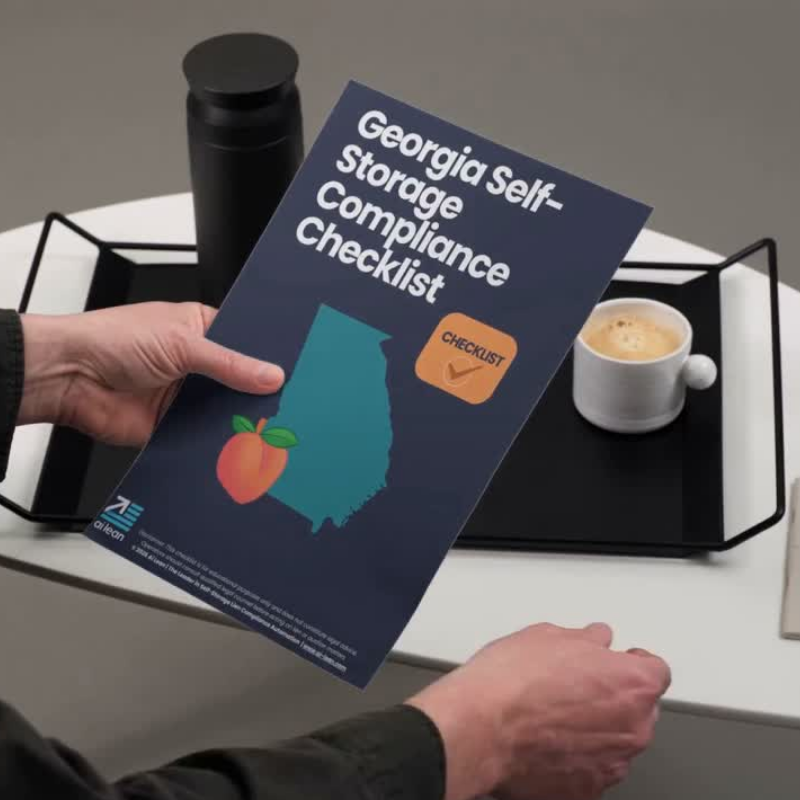
Get Your Copy Today!
Download this 10-page Georgia Self-Storage Compliance Checklist for an overview of lien requirements, notices, publication rules, and vehicle procedures.
Disclaimer: This checklist is for educational purposes only and does not constitute legal advice.
The Timeline: From Default to Sale
Here's what most operators get wrong—they don't count the days correctly. Georgia's timeline is strict and unforgiving:
30 Days of Continuous Default
Your tenant must be in default for a full 30 days before you can do anything. If rent is due on the 1st and late after the 5th, you're counting from the 6th. Accept a partial payment? The clock may reset to zero.
Pro tip: Document everything. If you accept partial payments, get a written agreement specifying what it covers and whether the default period continues.
Preliminary Lien Notice (Minimum 14 Days)
After 30 days of default, send your lien notice. This must include seven specific elements:
Itemized statement of what's owed and when it became due
Access denial notice (the tenant can no longer access their unit)
Your contact information (name, address, email, phone)
Payment demand with at least 14 days to pay
Sale warning (if not paid, property will be advertised and sold)
Property description and unit location
Redemption rights information
Send it via certified mail, registered mail, overnight delivery, or email. Here's the catch with email: If you don't get a non-automated response or delivery receipt, you must also send verified mail to their physical address. Skip this backup and your notice is invalid.
Two-Week Advertisement Period
After your 14-day payment demand expires, publish your advertisement once a week for two consecutive weeks in the county's legal organ (the official newspaper designated for legal notices—verify this with the county clerk).
Your ad must include:
Brief description of the property
Facility address
Unit number
Tenant's name
Exact time, place, and manner of sale
No newspaper in your area? Post the notice in at least six conspicuous public places at least 10 days before the sale.
15-Day Waiting Period
Your sale cannot happen sooner than 15 days after the first publication.
Do the math: 30 days default + 14 days payment demand + 2 weeks publication + 15 days waiting = approximately 60 days minimum from initial default to earliest possible sale.
The Two Rules You Cannot Break
Rule #1: Always Verify Military Status
The Servicemembers Civil Relief Act (SCRA) is the single biggest legal landmine in lien enforcement. Active-duty servicemembers and their dependents have ironclad protections—you cannot enforce a lien without a court order during active duty plus 90 days after discharge.
The penalty for violations? $130,000-$170,000 settlements are common, plus actual damages, attorney fees, and potential imprisonment in egregious cases.
The solution takes 30 seconds: Use the Department of Defense SCRA Centralized Verification Service (scra.dmdc.osd.mil) before every sale. Print the certificate. File it. Done.
Rule #2: Stop Everything If You Hear "Bankruptcy"
When a tenant files bankruptcy, an automatic stay takes effect immediately that halts all collection activity—including lien sales. You don't need formal court notice. Even a verbal statement that they "plan to file bankruptcy" puts you on notice.
Proceeding anyway is contempt of court. The consequences include monetary sanctions, attorney fees, and potential criminal penalties.
If you learn about a bankruptcy filing, immediately:
Stop all lien proceedings
Cancel any scheduled auctions
Cease collection communications
Contact the bankruptcy trustee or debtor's attorney
Conducting the Sale: Three Independent Bidders or Bust
Georgia allows sales at your facility, at the nearest suitable location, or online through platforms like StorageTreasures.com or Lockerfox. No auctioneer license is required—this is incidental to your business.
But here's the standard: A sale is generally deemed "commercially reasonable" if at least three independent bidders attend or participate. An independent bidder is someone not related to you and with no common financial interest.
Fewer than three bidders? Best practice is to stop the sale and reschedule with new advertising. Proceeding anyway risks the court finding the sale commercially unreasonable, which can void everything.
Critical tenant protection: Tenants can redeem their property at any time before the sale by paying all amounts due plus your reasonable expenses. If someone shows up with cash before bidding starts, you must accept payment and cancel the sale.
After the Sale: Handle Surplus Properly
When you sell the property, apply proceeds to what you're owed: rent, fees, expenses, advertising costs, auction fees, and reasonable administrative charges.
If there's money left over, you must hold the surplus for the tenant or any notified lienholders. This isn't optional—the statute says "shall."
Here's what to do:
Calculate surplus immediately
Notify the tenant of the amount
Hold it in a segregated account for two years
If unclaimed after two years, report and remit it to the Georgia Department of Revenue Unclaimed Property Division
Liability protection: Your liability can never exceed the sale proceeds. If the tenant later claims their property was worth more, your maximum exposure is what you actually got at auction.
The Top 5 Mistakes Georgia Operators Make
1. Counting Days Wrong
Sending notice even one day early invalidates everything. Use calendar aids or software automation. When in doubt, wait an extra day.
2. Using Outdated Notice Templates
Many software platforms use generic templates that don't include Georgia-specific required language. Have an attorney review your templates annually. Or look into automated software like Ai Lean that handles it for you!
3. Email Without Postal Backup
Georgia requires verified mail backup if email doesn't generate a delivery receipt. Email-only notices without this backup are invalid.
4. Publishing in the Wrong Newspaper
You must use the official "legal organ" designated by the county, not just any newspaper. Verify with the county clerk.
5. Accepting Partial Payments Without Written Agreements
Accepting money after default starts may reset the clock. Get written agreements specifying what the payment covers and whether the default period continues.
Your Pre-Sale Compliance Checklist
Before conducting any lien sale, verify:
☐ 30+ days continuous default (documented)
☐ SCRA verification completed and certificate retained
☐ No bankruptcy filing
☐ Notice sent after full 30-day default period
☐ Notice includes all seven required elements
☐ Proof of delivery obtained (certified mail receipt or email confirmation + postal backup)
☐ Full 14 days allowed from notice to demand deadline
☐ Advertisement in correct legal organ newspaper
☐ Published once weekly for two consecutive weeks
☐ Advertisement includes all five required elements
☐ Affidavit of publication obtained
☐ Minimum 15 days from first publication to sale
☐ Three independent bidders present or online
☐ Detailed documentation of entire process
Download our full checklist >> See above.
Prevention Is Better Than Perfection
Here's the secret successful operators know: The best lien sale is no lien sale.
Facilities with strong preventive systems conduct 70-80% fewer auctions while maintaining lower delinquency rates. The key is proactive communication:
Send payment reminders before rent is due
Maintain accurate contact information (primary, alternate, and emergency contacts)
Reach tenants through multiple channels (email, text, phone, mail)
Document every communication attempt
Intervene early when accounts become delinquent
Technology helps: Modern self-storage management software with integrated lien enforcement capabilities eliminates timing calculation errors and generates compliant notices automatically. But never rely on default templates without legal review—have a Georgia attorney approve your specific notice templates.
Special Situations You Need to Know
Deceased Tenants: Overlock the unit immediately. Require proper legal documentation before releasing property: death certificate, letters testamentary from probate court, or court order. Never release based solely on family relationship claims.
Vehicles: Georgia offers a simpler alternative for vehicles, trailers, and watercraft. After 60 days default, you can have the property towed instead of conducting a lien sale. Once the towing company takes possession, you have no further liability. This is often easier than dealing with title issues.
Hazardous Materials: If discovered, do not auction. Contact hazardous waste disposal authorities, arrange proper disposal through licensed handlers, document all costs, and add them to the tenant's debt.
Resources for Georgia Operators
Georgia Code Title 10, Chapter 4, Article 5
https://law.justia.com/codes/georgia/title-10/chapter-4/article-5/
Complete statutory text with all amendments through 2024
Georgia Self Storage Association (GASSA)
https://www.gassa.org/
State association providing legal consulting, lease templates, and compliance resources. Annual membership $250.
Self Storage Legal Network
https://www.selfstoragelaw.com/
Unlimited legal consultations for association members. Offers state-specific lien law manuals and rental agreement handbooks.
DOD SCRA Verification Service
https://scra.dmdc.osd.mil/
Free instant verification of military status. Essential for compliance.
The Bottom Line
Georgia's lien law gives you powerful enforcement rights—but demands absolute precision in return. One missed deadline, one incomplete notice, one overlooked SCRA verification can invalidate months of work and create substantial liability.
The operators who succeed balance three elements:
Understanding the law's specific requirements
Implementing systems that ensure consistent compliance
Recognizing when to consult legal counsel
Most lien sale problems arise from preventable administrative mistakes. Invest in proper training, use technology to eliminate calculation errors, implement two-person verification before every sale, and maintain relationships with qualified attorneys who know Georgia self-storage law.
Your statutory lien is a valuable tool for protecting revenue. Used correctly, it keeps your facility financially healthy. Used carelessly, it becomes an expensive liability.
Don't leave it to chance.
Need help implementing compliant lien procedures at your Georgia facility? The Georgia Self Storage Association and Self Storage Legal Network provide ongoing support, updated templates, and legal consultation specifically for Georgia operators. Because in lien enforcement, what you don't know absolutely can hurt you.
This blog post reflects Georgia lien law as of December 1, 2025. It is provided for informational purposes only and does not constitute legal advice. Always consult a Georgia-licensed attorney before enforcing any lien under O.C.G.A. §§ 10‑4‑210 through 10‑4‑218.
ABOUT AI LEAN
Ai Lean is the leading automated delinquency and lien enforcement platform built specifically for self-storage operators. Our state-specific compliance engine handles the complex requirements of Georgia's 60-day lien process, email backup rules, and federal SCRA protections—so you can recover revenue faster while eliminating legal risk.
Trusted by operators managing 1000+ facilities nationwide, Ai Lean integrates seamlessly with major property management systems and provides:
Automated, compliant notice generation and delivery
Intelligent timeline tracking with state-specific rules
Integrated SCRA verification and bankruptcy monitoring
Complete documentation and audit trails
Real-time reporting and analytics
Dedicated compliance support team
The result? Lower delinquency rates, faster unit turnover, reduced legal exposure, and staff freed to focus on customer service and facility growth instead of paperwork.
Related Resources
The Complete Guide to Self-Storage Lien Compliance & Risk Management
How to Get Sued in 4 Easy Steps: A Self-Storage Operator's Guide to Manual Lien Compliance
New Lien Law Pitfalls: How a 9pm Notice Could Cost You $1000
Automating Lien Compliance: The Secret Weapon for Self-Storage Profitability in a Tight Market
From Delinquency to Dominance: How Ai Lean Helped Storage Star Cut Delinquency by 80%
-
Self-Storage Compliance Hub
- Jan 20, 2026 California’s 2026 Lien Law Changes: Small Updates, Big Operational Impact
- Jan 9, 2026 Florida Self-Storage Lien Law: A Compliance Guide for Self-Storage Operators
- Dec 22, 2025 Georgia Self-Storage Lien Law: The Operator's Guide to Risk-Free Enforcement
- Dec 16, 2025 How Do Self-Storage Operators Stay Compliant With Lien Laws Across States?
- Nov 20, 2025 Military Tenant Protections: SCRA Compliance for Self-Storage Operators
- Nov 5, 2025 Can You Automate Self-Storage Delinquency Management?
- Oct 20, 2025 The Human Factor in Automation: Training Staff to Work Alongside Digital Compliance Tools
- Oct 16, 2025 How Much Time Does Delinquency Management Take Self-Storage Managers?
- Oct 7, 2025 Storage Lien Automation vs Manual Processing: Complete 2025 Comparison
- Oct 6, 2025 How to Get Sued Series: Part 4 - Documentation Disasters
- Sep 29, 2025 How to Get Sued Series: Part 3 - Auction Accidents
- Aug 28, 2025 How to Get Sued Series: Part 2 - State Law Stumbles
- Jul 29, 2025 How to Get Sued Series: Part 1 - Notification Nightmares
- Jun 25, 2025 The True Cost of Manual Lien Management: Calculating Your Compliance Burden
- Jun 16, 2025 Self-Storage Lien Notices: Templates, Requirements, and Delivery Methods
- May 28, 2025 The Self-Storage Auction Process: A Step-by-Step Compliance Guide
- May 20, 2025 California's Self-Storage Lien Laws: How to Navigate in 2025
- May 19, 2025 Texas Self-Storage Lien Law Guide: Compliance Requirements
- May 15, 2025 The Complete Guide to Self-Storage Lien Compliance & Risk Management
-
State Lien Laws
- Jan 20, 2026 California’s 2026 Lien Law Changes: Small Updates, Big Operational Impact
- Jan 9, 2026 Florida Self-Storage Lien Law: A Compliance Guide for Self-Storage Operators
- Dec 22, 2025 Georgia Self-Storage Lien Law: The Operator's Guide to Risk-Free Enforcement
- May 20, 2025 California's Self-Storage Lien Laws: How to Navigate in 2025
- May 19, 2025 Texas Self-Storage Lien Law Guide: Compliance Requirements
