When Self-Storage Operators Get Sued: What the Courtroom Can Teach Us

Executive Summary
Self-storage operators face significant legal exposure from wrongful lien sales — and the cases making it to court reveal that most failures stem from process gaps, not bad intent.
Nearly half of operators experienced a lien-related legal challenge between 2020 and 2023.
Three public cases — Gonzales v. Personal Storage ($379K judgment), a Los Angeles Superior Court suit against Public Storage, and a 2024 DOJ action against Morningstar Storage ($130K settlement) — illustrate how notice failures, procedural resets, and missing military status checks can trigger serious financial and legal consequences.
The pattern is consistent: manual processes and inconsistent compliance procedures are the root cause. Operators managing delinquency without systematic, automated safeguards are carrying more risk than most realize.
Part of Ai Lean’s Hidden Liability Series — a practical look at the operational, compliance, and financial risks quietly impacting self-storage operators today. Each article breaks down where manual processes create exposure and what disciplined operators are doing differently.
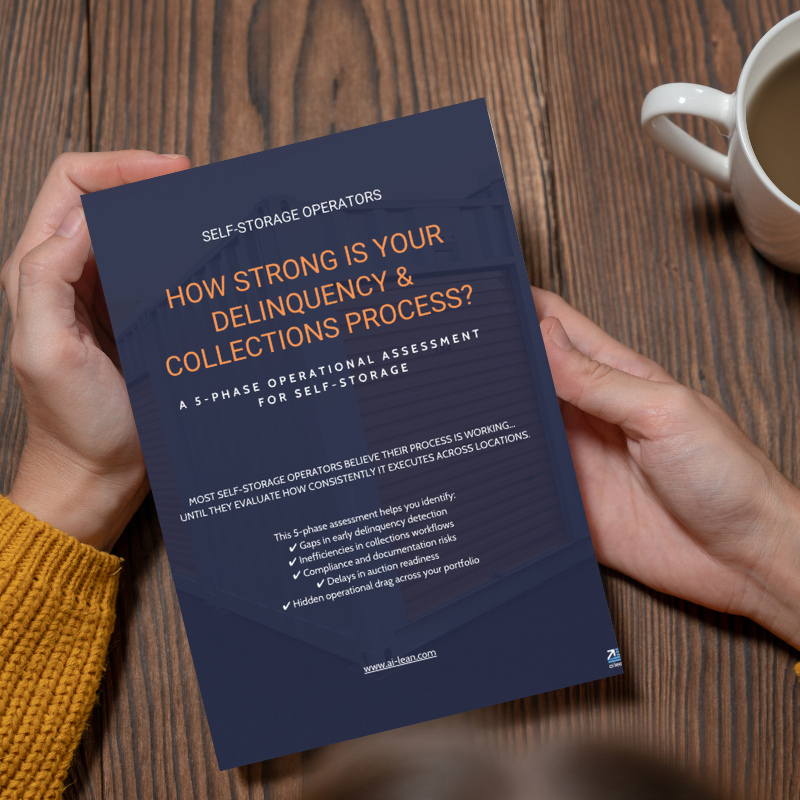
Want to Evaluate Your Own Operations?
Download the Self-Storage Operational Discipline Assessment to evaluate how well your current systems support disciplined operations.
Most self-storage operators who end up in court over a wrongful sale never planned to break the law.
They weren't negligent in the careless sense of the word.
They were busy… managing multiple locations, onboarding new staff, handling a delinquency backlog. And somewhere in that busyness, a process step got missed.
That's the uncomfortable lesson buried in years of self-storage litigation: the lawsuits that hurt operators most aren't the result of bad intentions.
They're the result of broken processes. And in an industry where lien law compliance is both legally required and operationally complex, broken processes have a way of becoming very expensive very fast.
The Scale of the Problem
Let's start with a number that deserves more attention than it typically gets: according to a 2023 industry survey, nearly half of self-storage operators — 47% — experienced at least one lien-related legal challenge between 2020 and 2023.
That's not a fringe issue. That's an industry-wide exposure that most operators aren't actively managing!
Wrongful sale claims are consistently ranked as the top legal challenge facing the industry. And unlike slip-and-fall liability, which your general commercial insurance typically covers, most standard policies provide little to no protection during the lien sale process — precisely when you're most exposed.
What the Cases Actually Show
Three cases from public record illustrate the pattern clearly — and they span different types of operators, different failure modes, and different financial consequences.
Case 1: Gonzales v. Personal Storage, Inc. (California, 1997)
This is the case that still gets cited in self-storage legal training decades later, and for good reason.
A California tenant fell behind on rent. The facility sent the required preliminary lien notice and notice of lien sale — correctly. The tenant paid $500 and was told her account was current. Then she missed a payment again the following January.
Here's where it went wrong: rather than issuing a new preliminary lien notice and new notice of lien sale as required under the California Self-Storage Facility Act, the facility simply cut her lock and arranged for an auction.
The court found that Personal Storage had no legal right to proceed to sale without re-issuing the required notices. The jury awarded the tenant $59,559 in property damages, $232,582 in emotional distress damages, and $87,466 for conversion — a total judgment exceeding $379,000.
The kicker? The facility had followed the right process the first time. They just didn't follow it again when it was required a second time.
Case 2:Public Storage (Los Angeles Superior Court, Case BC562265)
A wrongful sale lawsuit was filed in Los Angeles Superior Court against Public Storage, one of the largest self-storage REITs in the country, alleging the company auctioned a tenant's belongings in violation of California's Self-Service Storage Act. The suit alleged breach of contract, negligent infliction of emotional distress, and unfair business practices — and sought punitive damages.
This case is instructive not because of Public Storage's scale, but because it demonstrates that size and sophistication are not a shield. If a REIT with dedicated legal resources and compliance teams can find itself in court over lien process failures, smaller operators running manual systems or patchwork technology are at considerably higher risk.
Case 3: United States v. Morningstar Storage (U.S. Department of Justice, September 2024)
This is the one of the more recent and arguably the most instructive case — because it resulted in federal intervention and a consent order, not just a civil dispute.
Morningstar Storage, a 250-facility operator across 17 states, agreed to pay $130,000 to resolve allegations that it violated the Servicemembers Civil Relief Act (SCRA) by auctioning the belongings of at least three active-duty service members without first obtaining required court orders.
One of those service members was an Air Force Staff Sergeant stationed at MacDill Air Force Base in Tampa. When she signed her storage agreement, she indicated her active military status and authorized automatic rent payments. She then deployed to Jordan, storing nearly all of her household goods — including military awards, coins, and her children's keepsakes — at the facility.
The facility auctioned her belongings without seeking the court order the SCRA explicitly requires. The consent order required Morningstar to pay $80,000 to that service member, $5,000 each to two additional affected service members, and a $40,000 civil penalty to the U.S. government.
What makes this case particularly sobering is the strict liability dimension: under the SCRA, there is no requirement that a service member inform the lien holder of their military status. The obligation to check — and to obtain a court order if military service is confirmed — falls entirely on the operator. Running the process without a systematic check isn't just risky. In federal court, it may constitute a violation regardless of intent.
The Pattern Across All Three Cases
Look at what actually went wrong in each of these situations:
• In Gonzales, the failure was a procedural reset — the facility didn't recognize that a prior payment had restarted the notice requirement clock.
• In the Public Storage case, the allegation was a failure to follow the notice timeline after a declaration in opposition to lien sale was received.
• In Morningstar, the failure was a missing verification step — no one confirmed military status before proceeding to auction.
None of these were elaborate schemes. None required bad faith. They were process gaps — the kind that are easy to miss when compliance is managed manually, especially across multiple locations, multiple states, and multiple staff members who each interpret the process slightly differently.
As self-storage attorney Murphy Klasing has written in Inside Self-Storage:
"Wrongful-sale lawsuits will likely always be your number one self-storage legal challenge. Even when you do everything right, it won't stop a tenant from filing a claim against you."
If that's true when you do everything right, the exposure when your process has gaps is considerably higher.
What Operators Should Take Away
The litigation record points to three categories of risk that operators should evaluate honestly:
• Notice process integrity Every step in the lien notice sequence has legal significance — and in many states, a payment that partially satisfies a balance, or a tenant communication that constitutes a dispute, can reset the clock entirely. Manual tracking makes it easy to miss these resets.
• Multi-state complexity State lien laws are not uniform. Notice timing windows, acceptable delivery methods, publication requirements, and redemption period rules all vary — and several states have updated their statutes in recent years. Operating in multiple states with a single process template is a compliance liability.
• Military status verification The SCRA requirement is a strict liability standard at the federal level. If you don't have a systematic check built into your pre-auction process, you are carrying exposure that may not be covered by your standard insurance.
The Real Cost of a Process Failure
Beyond the legal judgments themselves, there are downstream costs that don't show up in case summaries: legal defense fees that often exceed the underlying claim amount, staff time diverted to litigation support, reputational damage in local markets, and in the case of federal SCRA violations, the prospect of ongoing oversight through a consent order.
Self-storage lien law compliance isn't a back-office administrative task.
It's a risk management function — and treating it as anything less is exactly how operators end up in the cases described above.
Over the next several weeks, we'll be looking at where compliance breaks down at scale, what a real audit trail needs to look like to protect you in court, and what the actual financial math of a process failure adds up to. If any of the cases above felt uncomfortably familiar, those posts are worth your time.
Sources
• Gonzales v. Personal Storage, Inc., 56 Cal. App. 4th 464 (Cal. Ct. App. 1997) | https://law.justia.com/cases/california/court-of-appeal/4th/56/464.html
• Wrongful-Sale Lawsuit Filed Against CA Public Storage Facility, Case BC562265 | Inside Self-Storage | https://www.insideselfstorage.com/self-storage-investing-real-estate/wrongful-sale-lawsuit-filed-against-ca-public-storage-facility
• United States v. Morningstar Properties LLC, No. 24-02208 (M.D. Fla., Sept. 19, 2024) | U.S. Department of Justice | https://www.justice.gov/usao-mdfl/pr/justice-department-secures-relief-morningstar-storage-resolve-alleged-violations
• SafeLease, Sale & Disposal Liability Explained (2023 industry survey — 47% stat) | https://www.safelease.com/resources/sale-disposal-liability-explained
• Klasing, M., A Lien Carries Great Power and Responsibility | Inside Self-Storage | https://www.insideselfstorage.com/legal-issues/a-lien-carries-great-power-and-responsibility-here-s-how-to-avoid-a-wrongful-self-storage-sale
• Servicemembers Civil Relief Act Centralized Verification Service, SCRA Storage Facility Rules | https://www.servicememberscivilreliefact.com/blog/scra-storage-facility-rules/
Frequently Asked Questions
Q: What is a wrongful sale in self-storage?
A wrongful sale occurs when a self-storage operator auctions a tenant's belongings without properly following state-mandated lien procedures — including required notices, waiting periods, and delivery methods. Even unintentional procedural errors can result in lawsuits and significant damages.
Q: What happens if a self-storage facility skips a required lien notice?
The operator loses the legal right to proceed with the sale. Courts have awarded tenants damages for property loss, emotional distress, and conversion — in some cases exceeding $300,000 for a single incident.
Q: Does standard commercial insurance cover wrongful lien sales?
Generally, no. Most standard commercial policies exclude coverage during the lien sale process. Operators typically need specialized Sale & Disposal Liability coverage to be protected.
Q: What is the SCRA and why does it matter for self-storage operators?
The Servicemembers Civil Relief Act (SCRA) requires operators to obtain a court order before auctioning the belongings of active-duty military members. It functions as a strict liability statute — operators are responsible for verifying military status regardless of whether the tenant discloses it.
Q: Can a self-storage operator be sued even if they followed the process correctly?
Yes. Wrongful sale claims are the industry's top legal challenge and can be filed even when an operator believes they acted properly. Documented, auditable compliance processes are the best defense.
Continue Reading