Operational Discipline Is the New Growth Strategy

The self-storage industry has entered a new phase.
After years of demand-driven growth, operators are now navigating tighter margins, leaner teams, and higher expectations for consistency and execution. The strategies that once delivered results — speed, expansion, and flexibility — are no longer enough on their own.
This shift defines what we’re calling The 2026 Operational Reality.
In this new reality, growth doesn’t come from doing more.
It comes from operational discipline — consistent execution, reliable systems, and reduced variability across portfolios.
This article is the first in The 2026 Operational Reality Series, which explores how leading self-storage operators are adapting to the market as it actually exists today — not the one they wish they were still in.
“You can’t run facilities with mediocrity anymore. To achieve the same margins, you actually have to run the business well.”
Executive Summary
In 2026, self-storage growth is no longer driven primarily by expansion or speed. Tighter margins, increased scrutiny, and leaner teams mean that consistent execution and reliable systems now determine performance. Operators who prioritize operational discipline — clear processes, enforced timelines, and reduced variability — are better positioned to protect margin, reduce risk, and scale sustainably.
The Market No Longer Forgives Sloppiness
During high-growth periods, inefficiency is easy to ignore. Units are full. Revenue is rising. Teams work around broken processes with experience and effort.
But when demand softens and margins tighten, those same inefficiencies surface quickly.
Missed timelines delay auctions. Manual rework consumes staff time. Fragmented systems introduce errors that require leadership attention. What once felt manageable becomes a drag on performance.
In this environment, growth doesn’t come from more activity. It comes from removing friction.
“What we’re hearing now isn’t just ‘how do we reduce delinquency?’ It’s ‘how do we support growth without adding cost.’ Operators want to be more efficient with the resources they already have.”
What “Operational Discipline” Really Means
Operational discipline is often misunderstood as bureaucracy or rigidity. In practice, it’s the opposite.
Disciplined operations are calm operations.
They are characterized by:
Processes that work without heroics
Systems that enforce rules consistently
Clear accountability without micromanagement
Fewer exceptions and less rework
When discipline is present, results don’t depend on who is working that day or how busy the week becomes. Outcomes are predictable.
“Operators are looking to automate and centralize processes to take away from busywork and give them time back in their day.”
Reactive Operations vs. Operational Discipline (2026)
The difference between reactive operations and operational discipline in self-storage comes down to how processes, compliance, and risk are managed. The comparison below highlights how disciplined operators in 2026 are moving from manual, fragmented, and reactive workflows to standardized, automated systems that protect margins and reduce operational risk.
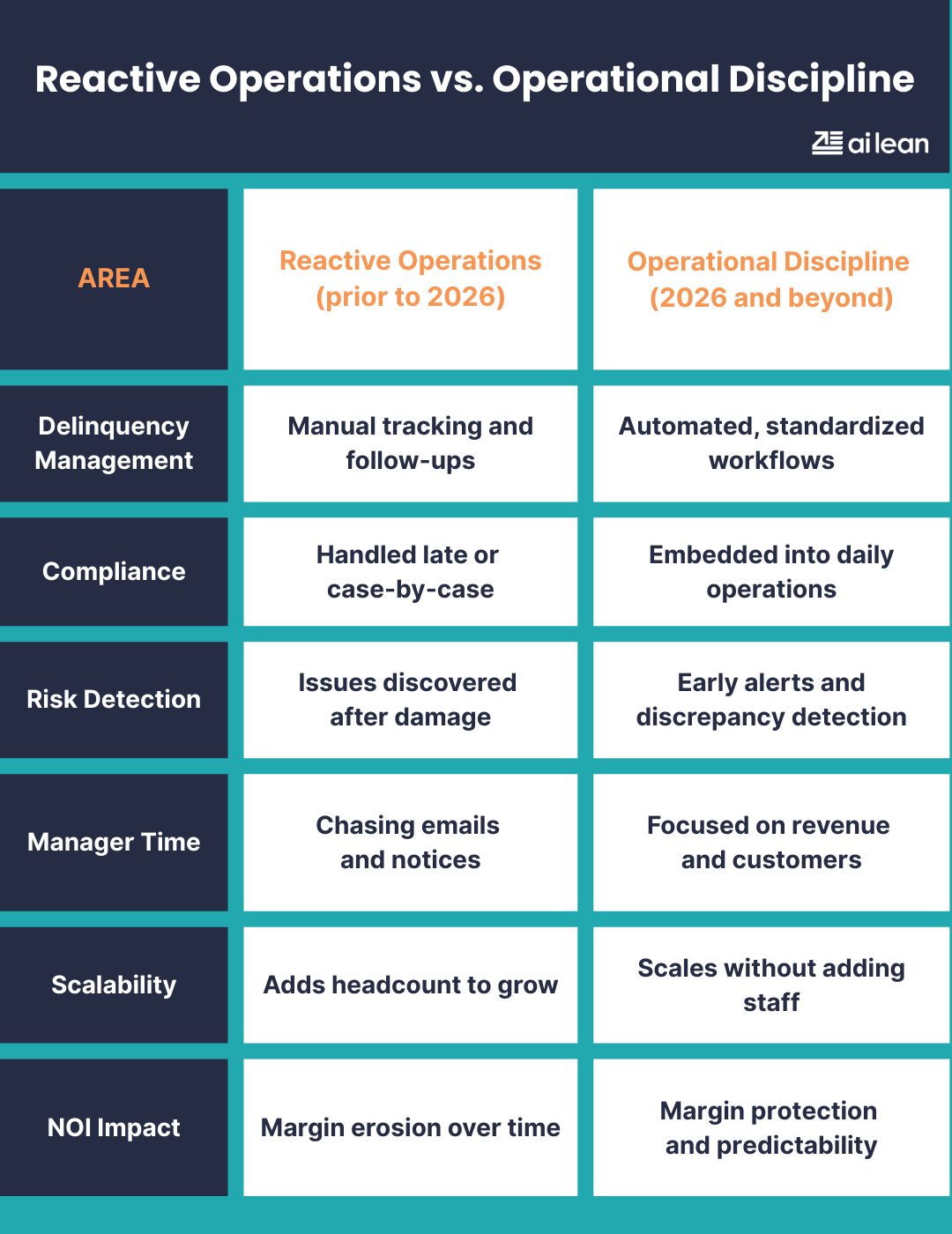
In 2026, disciplined self-storage operators win by standardizing workflows, embedding compliance, and reducing manual effort.
Key differences in 2026:
Reactive operations rely on manual tracking and late interventions
Operational discipline embeds compliance into daily workflows
Disciplined teams detect risk early instead of fixing it later
Automation allows scale without adding headcount
Why Discipline Now Equals Growth
In 2026, operational discipline directly impacts growth in several ways:
First, it protects margin. Reducing rework, delays, and errors lowers operating costs without cutting service or staff.
Second, it reduces risk. Consistent execution limits compliance exposure, customer disputes, and leadership distraction.
Third, it enables scale. Disciplined systems allow operators to grow portfolios without adding proportional headcount or complexity.
In other words, discipline creates leverage.
The Shift Operators Are Already Making
Across the industry, a quiet shift is underway.
Operators are:
Standardizing workflows instead of customizing them by location
Replacing manual tracking with system-enforced timelines
Focusing on fewer metrics that actually indicate health
Designing operations to withstand pressure, not just normal days
This isn’t about perfection. It’s about reliability.
Discipline Scales. Chaos Does Not.
Growth doesn’t fix operational problems — it multiplies them!
If your operations are:
Manual → scale multiplies labor costs
Inconsistent → scale multiplies risk
Reactive → scale multiplies delays
But if your operations are disciplined:
Scale increases efficiency
Scale improves predictability
Scale protects margins
This is why operational leaders are becoming the quiet heroes of the industry — and why operational maturity is now a competitive advantage.
“As operators expand, the pressure isn’t just internal. Investors and LPs are watching closely. If delinquency or costs creep up, it becomes a serious issue fast.”
Compliance Is No Longer Optional Background Noise
In 2025, compliance moved from “legal housekeeping” to operational risk management.
Operators are navigating:
State-by-state lien law complexity
Heightened scrutiny around wrongful sales
SCRA obligations and edge-case tenant scenarios
Increased legal enforcement pressure
The disciplined operators aren’t reacting to compliance issues — they’ve embedded compliance into daily workflows.
Not because it’s exciting.
But because it’s cheaper than fixing mistakes after the fact.
“We bring up DOJ enforcement and military protections on almost every call now. Operators are realizing compliance isn’t optional background noise anymore.”
The Takeaway
The 2026 Operational Reality is clear: growth no longer comes from speed, expansion, or added headcount.
It comes from disciplined execution — systems that enforce consistency, reduce variability, and hold up under pressure.
Operators who embrace this reality are building organizations that scale calmly, protect margin, and reduce risk in a more demanding market.
This article is the foundation of The 2026 Operational Reality Series, which explores how leading self-storage operators are adapting to the market as it actually exists today — and what disciplined operations make possible next.
See what disciplined operations look like in practice!
Book a demo to see how Ai Lean helps operators enforce timelines, reduce risk, and scale without adding cost.
Operational Discipline Series
From Pandemic Playbook to Post-Boom Reality: Why Old Systems Are Failing Operators Now
3 System Signals That Are Quietly Limiting Performance
Why “Doing More” Is Hurting Self-Storage Operations in 2026
When More Oversight Slows Execution
The Cost of Fragmentation: How Disconnected Systems Quietly Erode Margin
Identify Your Holes & Opportunities!

Is Your Collections & Delinquency Process Costing You?
Our new Collections & Delinquency Process Audit helps you quickly assess the strength of your current process, from early detection all the way through auction.
Sources / References
Self-Storage Industry Sources
Self Storage Association (SSA)
SSA Industry Reports / Market Outlooks
Operations, Efficiency & Discipline (General Business)
McKinsey & Company – Operational Excellence
https://www.mckinsey.com/capabilities/operations/our-insights
https://www.mckinsey.com/business-functions/operations/our-insights/operational-excellence
Deloitte – Scalable & Disciplined Operations
https://www.deloitte.com/global/en/services/consulting/topics/operational-excellence.html
https://www.deloitte.com/global/en/services/consulting/scaling-operations.html
Harvard Business Review – Operational Discipline & Complexity
Regulation, Risk & Governance
U.S. Department of Justice (DOJ) – Consumer Protection
Consumer Financial Protection Bureau (CFPB) – Enforcement Trends
Systems & Fragmentation
Gartner – Cost of Fragmented Systems
Continue Reading