Why “Doing More” Is Hurting Self-Storage Operations in 2026
When performance starts to slip, the instinct is almost universal: do more.
Add another report.
Add another approval step.
Add another tool.
Add another checklist.
On the surface, it feels responsible. Activity increases. Oversight appears stronger. Teams stay busy.
But in 2026, many self-storage operators are discovering an uncomfortable truth: doing more is often making operations worse, not better.
Executive Summary
In a tighter market, adding tasks, tools, and oversight often increases complexity without improving outcomes. In 2026, many self-storage operators are experiencing slower execution, higher error rates, and greater operational drag because they’ve layered more onto already fragile systems.
High-performing operators are winning by simplifying, standardizing, and enforcing fewer — but better — processes.
This article is part of The 2026 Operational Reality Series, examining how self-storage operators are adapting their operations to succeed in a tighter, more disciplined market.
Why “More” Feels Like the Right Answer
When margins tighten and scrutiny increases, leadership pressure rises. Teams are expected to catch more issues, document more steps, and prevent more mistakes.
So operators respond by:
Adding layers of review
Creating new reports
Introducing additional tools
Expanding manual checks
Each decision makes sense in isolation. Together, they create a system that’s harder to run, harder to train, and harder to scale.
More activity becomes a substitute for better design.
The Hidden Cost of Operational Complexity
Complexity doesn’t usually announce itself as a problem. It shows up quietly.
→Execution slows
→Errors increase
→Re-visting work becomes normalized
→Teams feel busy but ineffective
Each added step creates another handoff. Each handoff introduces risk. Over time, teams spend more energy managing the process than achieving the outcome.
This is the complexity tax. And most operators underestimate how much it costs.
Why High-Performing Operators Are Doing Less
The most disciplined operators aren’t adding more controls. They’re removing friction.
They are:
Eliminating redundant steps
Standardizing workflows across locations
Automating enforcement of rules instead of checking them manually
Reducing reliance on memory and tribal knowledge
By doing less, they create systems that are easier to follow and harder to break.
Discipline, in practice, is subtractive.
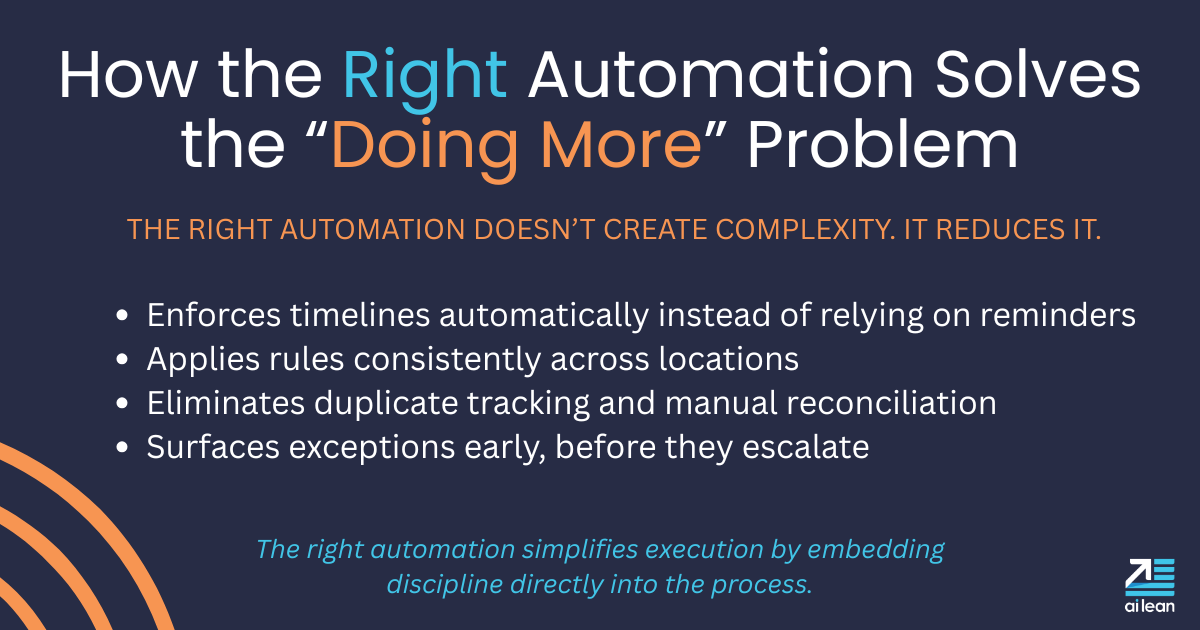
How the Right Automation Solves the “Doing More” Problem
The answer to operational overload isn’t adding more work — it’s removing manual effort where it doesn’t add value.
The right automation doesn’t create complexity.
It reduces it!
When automation is designed around operational discipline, it:
Enforces timelines automatically instead of relying on reminders
Applies rules consistently across locations
Eliminates duplicate tracking and manual reconciliation
Surfaces exceptions early, before they escalate
Most importantly, it allows teams to focus on decisions — not checklists.
This is where many operators go wrong.
They automate tasks without rethinking the system. The result is more tools, more alerts, and more noise.
The right automation does the opposite.
It simplifies execution by embedding discipline directly into the process.
The Difference Between Busy and Effective
Many struggling operations are extremely busy.
Emails fly. Reports get updated. Meetings fill calendars.
But activity isn’t the same as progress.
Effective operations produce predictable outcomes with minimal effort. Busy operations rely on constant motion to prevent failure. The difference is not effort — it’s design.
The Takeaway
In 2026, “doing more” is rarely the answer.
Operational maturity shows up as simplicity, consistency, and control. Operators who remove unnecessary complexity create faster execution, lower risk, and better outcomes — without burning out their teams.
Curious what this looks like in practice?
We offer a short, no-pressure walkthrough showing how disciplined automation can replace manual tracking and reduce operational drag across portfolios.
Book a demo to see how Ai Lean helps operators simplify delinquency and compliance management.
Identify Your Holes & Opportunities!

Is Your Collections & Delinquency Process Costing You?
Our new Collections & Delinquency Process Audit helps you quickly assess the strength of your current process, from early detection all the way through auction.
Frequently Asked Questions
Q: Why does operational complexity reduce performance?
A: Because each added step creates handoffs, delays, and error risk, slowing execution and increasing rework.
Q: Is simplification the same as cutting corners?
A: No. High-performing operators remove unnecessary steps while enforcing fewer, better-designed processes.
Q: Can automation actually reduce complexity?
A: Yes—when automation replaces manual tracking and enforcement instead of adding more tools and alerts.
Q: What’s the biggest mistake operators make with automation?
A: Automating tasks without redesigning the system, which often creates more noise instead of clarity.
Sources & References
Harvard Business Review – The High Cost of Efficiency
https://hbr.org/2019/03/the-high-cost-of-efficiencyHarvard Business Review – Why Complexity Is the Enemy of Execution
https://hbr.org/2017/07/why-complexity-is-the-enemy-of-executionMcKinsey & Company – Simplification as Strategy
https://www.mckinsey.com/capabilities/operations/our-insights
Operational Discipline Series
Operational Discipline Is the New Growth Strategy
From Pandemic Playbook to Post-Boom Reality: Why Old Systems Are Failing Operators Now
3 System Signals That Are Quietly Limiting Performance
Why “Doing More” Is Hurting Self-Storage Operations in 2026
When More Oversight Slows Execution
The Cost of Fragmentation: How Disconnected Systems Quietly Erode Margin
How Manual Workarounds Quietly Erode Operational Discipline
Why Operational Discipline Beats Headcount in 2026
Operational Discipline Is Becoming the New Competitive Advantage in Self-Storage (wrap up)
Continue Reading