When More Oversight Slows Execution
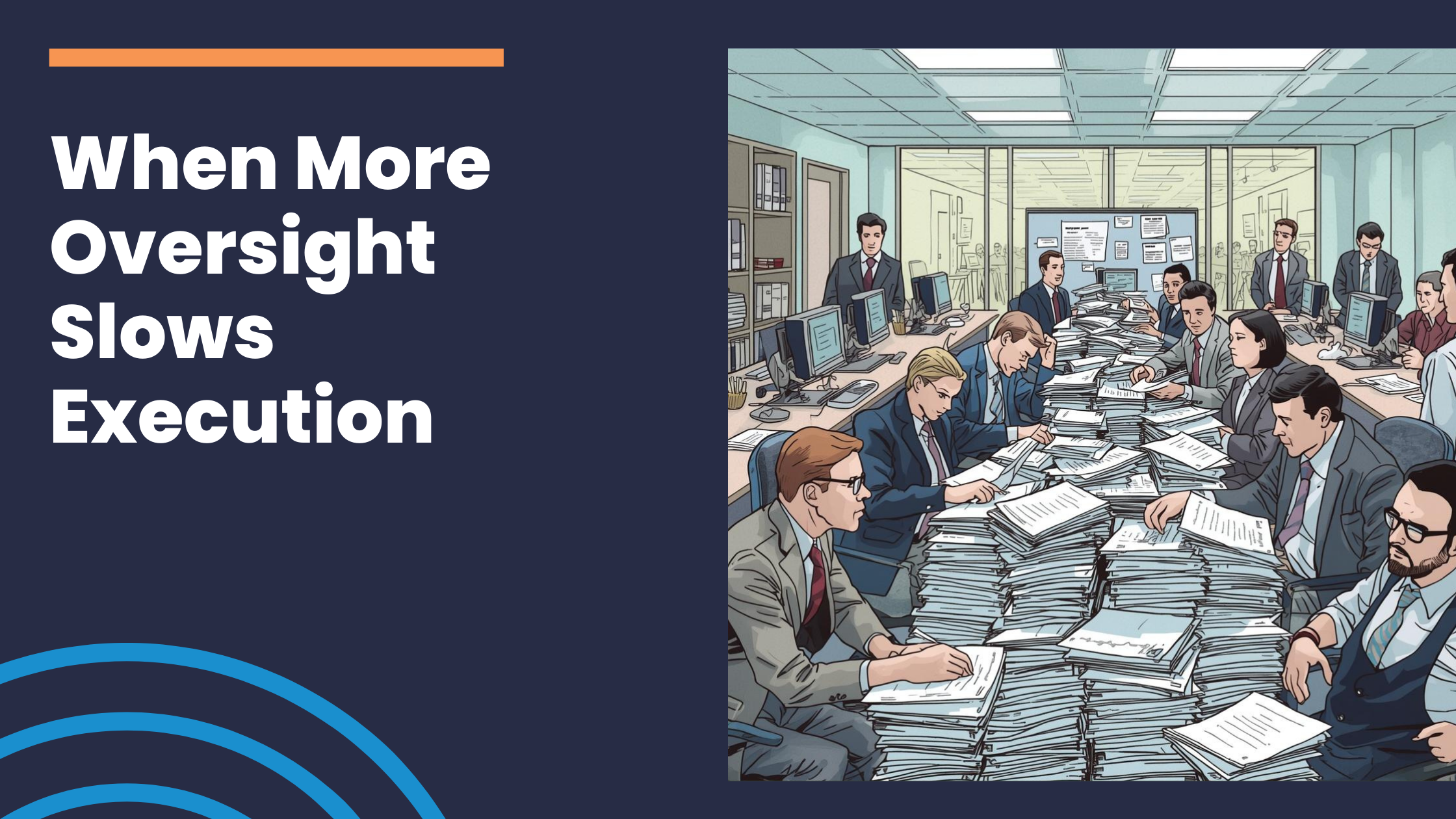
When performance starts to slip, the instinct is almost universal: Add oversight.
More approvals
More reports
More checks
On the surface, this feels responsible. Activity increases. Visibility appears stronger. Teams stay busy.
But in practice, added oversight often introduces new risk — not less.
Here’s how that shows up in day-to-day operations.
1. More Approvals Slow Execution at the Exact Wrong Moment
Additional approval steps are usually added to prevent mistakes.
What they often do instead:
Delay time-sensitive actions
Create bottlenecks when key approvers are unavailable
Encourage workarounds to “keep things moving”
Over time, teams learn which approvals are flexible, and which ones can be bypassed when pressure mounts.
That’s when consistency starts to erode.
Oversight that depends on availability isn’t control.
It’s a queue.
2. More Reports Create the Illusion of Visibility
Reports are meant to increase awareness.
But when reporting layers multiply, a different problem emerges:
Teams spend more time preparing reports than acting on them
Leaders review information after outcomes are already determined
Accountability shifts from execution to documentation
When visibility is retrospective, risk isn’t reduced — it’s delayed.
The operation may look controlled, even as small issues compound underneath the surface.
3. More Checks Shift Responsibility Away From the System
Manual checks are often introduced as safeguards.
In reality, they signal that:
The system doesn’t enforce the rule
The process depends on human memory
Consistency relies on judgment instead of design
As checks accumulate, responsibility subtly shifts:
From systems → people
From enforcement → verification
Teams spend more time confirming work than executing it.
That’s not discipline.
It’s drag.
Why This Becomes Riskier in 2026
In earlier growth cycles, added oversight felt manageable.
Margins absorbed inefficiencies.
Teams were larger.
Speed masked friction.
In today’s environment, that buffer is gone.
Lean teams, tighter timelines, and higher expectations mean every added step introduces:
Delay
Variability
Increased reliance on human intervention
The result isn’t fewer errors — it’s slower response when errors matter most.
A Better Question to Ask
Instead of asking:
“Where do we need more oversight?”
High-performing operators are asking:
“Where should the system enforce this without requiring oversight at all?”
That shift — from monitoring to enforcement — is where real operational discipline begins.
Bottom line
More oversight often feels like control.
In reality, it can create hidden risk by slowing execution, obscuring real issues, and pushing responsibility onto people instead of systems.
Where teams rely on added checks and approvals, it’s usually a sign the system isn’t doing enough of the work.
Curious what a fully, end-to-end process might look like?
We offer a short, no-pressure walkthrough showing how disciplined automation can replace manual tracking and reduce operational drag across portfolios.
Book a demo to see how Ai Lean helps operators simplify delinquency and compliance management.
Identify Your Holes & Opportunities!

Is Your Collections & Delinquency Process Costing You?
Our Collections & Delinquency Process Audit helps you quickly assess the strength of your current process, from early detection all the way through auction.
Frequently Asked Questions
Q: Why can more oversight increase risk instead of reducing it?
A: Because added approvals, checks, and reporting often slow time-sensitive actions and create bottlenecks—leading teams to rely on workarounds and inconsistent execution.
Q: What’s the difference between oversight and control?
A: Oversight is monitoring and reviewing after the fact. Control is having systems and processes that enforce consistent execution without requiring constant manual checking.
Q: When is added oversight actually appropriate?
A: When it’s temporary, targeted, and paired with a plan to remove the root cause—like a known process gap, unusual edge cases, compliance exposure, or new workflow rollout.
Q: What are common signs we’ve added too many checks or approvals?
A: Delays waiting for approvers, rising exceptions, more “just this once” workarounds, and teams spending more time documenting work than completing it.
Q: How should operators reduce risk without adding more layers?
A: Identify where delays and exceptions originate, simplify the workflow, and shift from manual verification toward system-enforced (automated) steps wherever possible.
Q: Is this anti-compliance or anti-accountability?
A: No. The point is to reduce human-dependent enforcement and improve consistency. Better-designed processes usually increase compliance and accountability
Operational Discipline Series
Operational Discipline Is the New Growth Strategy
From Pandemic Playbook to Post-Boom Reality: Why Old Systems Are Failing Operators Now
3 System Signals That Are Quietly Limiting Performance
Why “Doing More” Is Hurting Self-Storage Operations in 2026
When More Oversight Slows Execution
The Cost of Fragmentation: How Disconnected Systems Quietly Erode Margin
How Manual Workarounds Quietly Erode Operational Discipline
Why Operational Discipline Beats Headcount in 2026
Operational Discipline Is Becoming the New Competitive Advantage in Self-Storage (wrap up)
Continue Reading