Lien Compliance In-House vs. Outsourced: Count the Real Cost
Almost every operator we talk to asks the same question before anything else: "Is this cheaper than doing it ourselves?"
It's the right question. But the comparison usually goes wrong in the same place. A vendor price gets set next to one salary, maybe the person who "handles auctions," and the math looks simple.
It isn't. Lien work doesn't live in one job description. It lives in small pieces across your whole operation, and the most expensive piece doesn't show up on payroll at all.
Salary is easy to count. Exposure isn't.
THE WORK NEVER SITS WITH ONE PERSON
Follow a single delinquent unit from the first missed payment to auction day and count the hands that touch it.
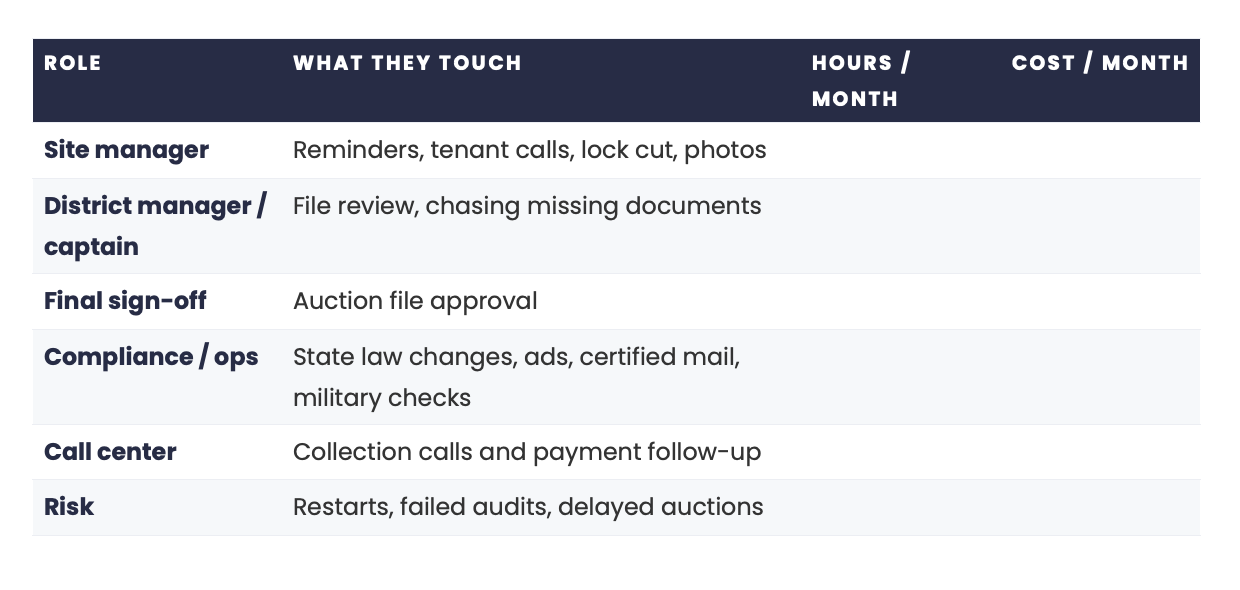
Site managers send reminders, take tenant calls, coordinate the lock cut, and photograph the unit.
A district manager or captain reviews the file and chases missing leases, mismatched addresses, and photos.
Someone signs off on the auction file before it goes live.
Someone else tracks state law changes, books newspaper ads, mails certified notices, and checks military status.
Each task feels small, so nobody tracks it. Spread across 20, 50, or 90 locations, it adds up to a job nobody was hired to do.
“AI Lean freed me up for a new role in my company. I no longer spend 75% of my day ensuring lien paperwork and files are correct for compliance with local and state statutes. This has benefited our company overall.”
WHEN THE PROCESS LIVES IN ONE PERSON'S HEAD
Many portfolios run their lien process through one meticulous person: the auction specialist with the checklist, the spreadsheet, and the memory for which state needs what. That person is usually excellent. That's the problem.
When the process depends on one careful person never having a bad week, every vacation, sick day, or resignation becomes a compliance risk. And when you add locations or enter a new state, you're asking that same person to carry more.
“Versus relying on one or two people in the company to be internal experts on lien law, we feel more confident now that we can go out to many, many states—because we have that resource available to us.”
THE COST OF ONE MISSED STEP
The in-house math almost always assumes every sale goes perfectly. In practice, the process breaks on small things:
The second newspaper ad that never ran
A lease name that doesn't match the tenant's ID
A tenant whose military status was never confirmed
A payment that posts the morning of the auction
Any one of these can restart the lien cycle, which means more weeks with a unit that isn't earning. Some put the sale itself at risk. None of them show up when you compare a vendor price to a salary.
Gut check: if your best auction person were out for two weeks during auction week, what would slip?
COUNT EVERY HAND: A SIMPLE WORKSHEET
Before you compare any vendor price to headcount, build the real number. It takes about an hour with the right people in the room.
List every role. Include every person who touches a delinquent unit, not just the one who "owns" auctions.
Write down what each role does. Notices, calls, photos, file review, sign-off, ads, mail, military checks.
Estimate monthly hours. Ask the people doing the work. The hours hide in small pieces.
Multiply. Use a loaded hourly cost, then total it across all locations.
Add the risk line. How many restarts, failed audits, or delayed auctions did you have last year? What did each cost in lost rent?
Add the growth line. How many more locations can this team absorb before you need to hire?
WHAT CHANGES WHEN ONE PARTNER OWNS THE LIFECYCLE
Intelligent recovery replaces a chain of handoffs with one process, from day one to day done. Ai Lean runs the recovery lifecycle from the first missed payment through auction: notices and mailing, file audits before a unit is cleared to sell, tasks assigned to the right person at the right location, and a complete audit trail for every tenant in one place.
Your team keeps the work only they can do on site, like the lock cut and photos. Everything else stops living in inboxes, spreadsheets, and one person's memory.
“Each of our regional managers has about 30% of their time back. We were on the edge of needing to hire another regional position. Implementing AI Lean removed that need.”
THE BETTER QUESTION
"Is this cheaper than our staff?" is a fair place to start. The better question is: what does it cost us to keep this in-house as we grow, and who carries the risk when a step gets missed?
Count every hand. Then decide.
Want Help Running the Numbers?
We'll walk through your current lien and auction workflow with you, role by role, and show you where the hours and the risk really sit.
FREQUENTLY ASKED QUESTIONS
Q1: How much does it cost to manage self-storage lien compliance in-house?
The cost is rarely one salary. Lien and auction work is spread across site managers, district or regional managers, file reviewers, and whoever signs off on the auction, plus mailing, newspaper ads, and military status checks. To get a real number, list every role that touches a delinquent unit, estimate their monthly hours on lien work, and multiply by a loaded hourly rate. Then add the cost of mistakes, such as restarted lien cycles and delayed auctions.
Q2: Who should own the lien and auction process at a multi-site self-storage operator?
Someone has to own the whole lifecycle, not just one step. In many portfolios, the process is split across site managers, district managers, and one detail-oriented specialist, which works until that person is out or the portfolio grows. Operators either build a dedicated in-house team with documented procedures or partner with a provider that owns the process end to end. The right answer depends on your growth plans and how much risk you want to keep in-house.
Q3: What are the most common mistakes in the self-storage lien process?
The most common misses are small administrative steps: a second newspaper ad that never ran, a lease name that does not match the tenant ID, an address that does not match the lease, or a tenant whose military status was never confirmed. Last-minute payments before an auction are another frequent gap. Each one can force a restart of the lien cycle or put the sale at risk. A clear audit before a unit is cleared to sell catches most of them.
Q4: How do I calculate the hours my team spends on delinquency and auctions?
Start with roles, not tasks. For each role that touches a delinquent unit, list what they do (notices, calls, photos, file review, sign-off, ad placement) and estimate hours per month. Ask the people doing the work rather than guessing from the top, because the hours are usually spread in small pieces. Multiply by a loaded hourly cost and total it across every location.
Q5: When should a self-storage operator consider outsourcing the lien process?
Consider it when the work depends on one or two internal experts, when you are adding locations or entering new states, or when district managers are spending time on paperwork instead of their sites. It is also worth a look if you have had restarts, failed audits, or a close call with a military tenant. Compare the full in-house cost, including risk and growth, against the cost of a partner that owns the lifecycle end to end.
Sources
Storage Star case study: "From Delinquency to Dominance" (500+ hours saved monthly) | internal | 2026
U.S. Department of Justice, Servicemembers Civil Relief Act | https://www.justice.gov/servicemembers | accessed Oct 2026
Continue Reading