The Real Cost of "Good Enough": A Self-Storage Compliance Reckoning

Executive Summary
This capstone post draws together over two months of compliance coverage — real wrongful-sale lawsuits, state lien law changes, the audit trail problem, and compliance cost calculations — into a single honest question:
Is your self-storage compliance process actually good enough?
The post surfaces the critical difference between "not broken" and "defensible," arguing that operators who have been running on the absence of past problems are carrying serious risk.
Eight self-assessment questions serve as a practical compliance self audit, covering template currency, documentation completeness, portfolio-wide visibility, and military verification.
This is the final post in Ai Lean’s Hidden Liability Series…. a practical look at the operational, compliance, and financial risks quietly impacting self-storage operators today.
The Question Most Operators Don't Ask
Somewhere in the process of scaling a self-storage business, most operators reach a point where compliance becomes "handled."
There's a system. There's a team. There's a vendor. Things have been running well enough, and well enough is good enough.
That's not complacency. You're simply busy, running a real business with real pressures, and compliance is one of a hundred things on your overstuffed list.
The lien process isn't broken, so why fixed it?
But "not broken" and "defensible" are different standards.
And the self-storage industry — between state law changes, SCRA enforcement actions, expanded debt collection regulations, and a surge in wrongful-sale litigation — is in a moment where "good enough" is genuinely no longer good enough.
This post is a capstone to the series we've been building over the past three months. The lawsuits are real. The compliance gaps are real. The audit trail problem is real. The cost math is real. This is where we pull those threads together into one honest question: Is your compliance process actually good enough — and do you know?
What We've Covered (And Why It All Connects)
We started in March with the lawsuits. Real cases where operators followed what they believed was the right process and ended up in court. An Arizona facility that settled for $80,000. A national operator that paid $130,000 in a DOJ SCRA enforcement action. These weren't bad actors. They were process failures.
We looked at the five compliance requirements operators most commonly get wrong: notice timing windows, certified mail requirements, publication procedures, redemption periods, and military status verification. Each one is a tripwire. Any one of them, handled incorrectly, can turn a routine lien sale into a lawsuit.
In April, we looked at the scale problem. A single-location operator making one mistake is bad. A 30-location operator running inconsistent processes across multiple states is a liability factory — and they often don't know it because no one has visibility across the whole portfolio. The fragmented vendor landscape makes this worse: one tool for lien search, another for auctions, spreadsheets filling the gaps. Every handoff is a failure point.
We covered the law changes. California revised its statutes twice in two years. Illinois updated its act. D.C. modernized its lien advertising and notice rules. Florida tightened its debt collection timing. The operators who missed these updates aren't running the wrong process. They're running the right process — for a law that no longer exists.
We shifted to the audit trail. The question isn't just "Did you follow the steps?" It's "Can you prove you followed the steps?" Documentation is your primary defense — and most operators don't have a clean, complete, searchable audit trail for every lien process they've run.
Then we did the math. Legal defense. Settlements. Staff time. Tied-up units. A single compliance failure at a single location costs $50,000–$100,000 in a mid-range scenario. For multi-state operators running manual processes, that's not a theoretical risk. It's a calculable liability built into the operating model.
The Self-Assessment: 8 Questions
Here are the questions we'd ask if we were doing an honest compliance audit of your operation right now. Answer them truthfully — and pay particular attention to any "I'm not sure" answers.
Do you know which states in your portfolio changed their lien laws in the last 24 months?
Are your notice templates current for every state you operate in — and when were they last reviewed?
Does every lien process produce a complete, timestamped, searchable documentation trail?
Can you pull the full audit record for any lien process from the last 12 months within one hour?
Does your process include a documented military status check before every auction?
Do you have visibility across all locations — from a single dashboard — into where every account is in the lien process?
Are your automated collections communications time-gated to comply with state debt collection rules?
When did you last receive a compliance update from your lien vendor?
If you answered "I'm not sure" to two or more of those questions, you're describing a compliance operation with meaningful, unquantified risk baked in.
Not because you're doing anything wrong — but because the structure of your process makes it difficult to know whether you are or not. And that uncertainty is itself a vulnerability.
The Honest Reckoning
The self-storage industry has an honest relationship with compliance for the most part.
Operators understand that lien law is serious.
Most are trying to do it right. But "trying" and "documented, consistent, scalable" are different standards, and the gap between them is where most of the legal and financial risk lives.
The "good enough" posture (we've never had a major problem, our team knows the process, we have a vendor for that) doesn't survive contact with a motivated plaintiff's attorney or a regulatory inquiry.
It doesn't scale when you add locations. It doesn't self-update when state laws change. And it doesn't produce the audit trail that protects you when someone challenges a sale.
What a Different Standard Looks Like
Operators who have moved past "good enough" describe the shift in similar terms.
It's not about adding complexity… it's about removing ambiguity.
When every step is automated, documented, and sequenced according to current state law, compliance stops being something you manage and becomes something that happens. You gain time. You gain confidence. You gain defensibility.
“We used to dread dealing with delinquency and auctions. Ai Lean made it seamless and stress-free, allowing us to focus on scaling the business. The results speak for themselves.”
Storage Star's experience — bad AR dropped from $1M to $120K in 90 days, delinquency below 2%, 500+ staff hours per month recovered — wasn't about technology for its own sake. It was about replacing a fragmented, manual, uncertain process with one that was consistent, documented, and defensible.
Ready for a Real Answer?
If you answered "I'm not sure" to more than two of the questions above, we'd love to chat with you.
Ai Lean offers an ops review for self-storage operators who want an honest assessment of their current lien management process — where the gaps are, what they're costing, and what a different standard would look like in their specific context.
There's no obligation. Just a direct conversation about where your operation stands and what it would take to move from "good enough" to genuinely protected.
Ready to go from uncertain to defensible?
Request an ops review here
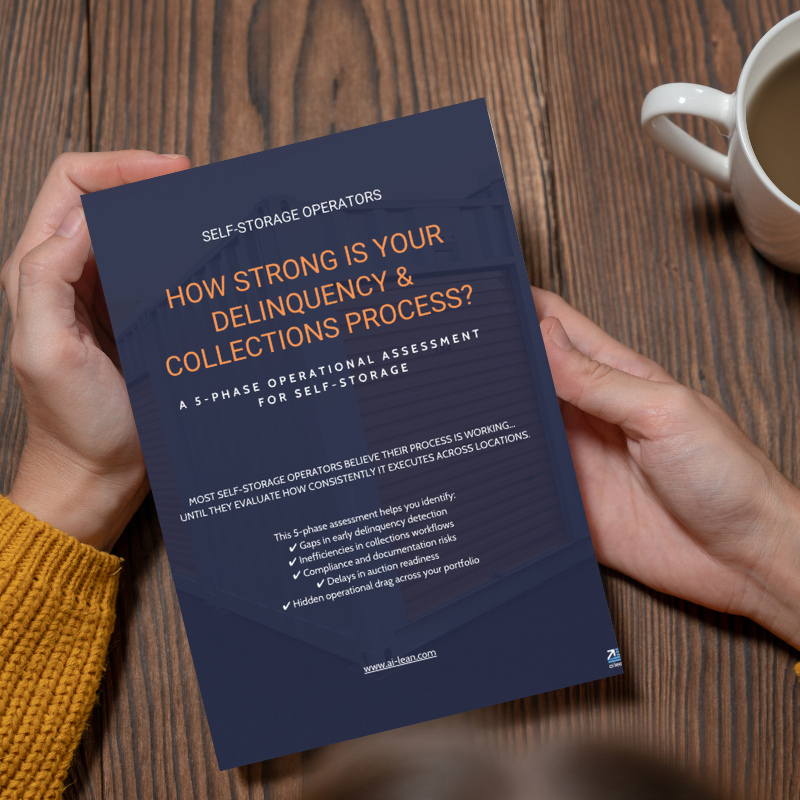
Want to Evaluate Your Own Operations?
Download the Self-Storage Operational Discipline Assessment to evaluate how well your current systems support disciplined operations.
Sources & References
Lawsuits & Enforcement (Referenced Throughout Series)
U.S. Department of Justice — United States v. Morningstar Properties (M.D. Fla.) — SCRA enforcement, $130,000 settlement (2024)
Piccuta Law Firm / SafeLease — Arizona wrongful-sale settlement, $80,000 (2018)
DOJ SCRA Program — $481M+ in total SCRA enforcement since 2011
State Law Changes
California AB 1916 (eff. Jan 1, 2025), AB 542 (2023), SB 1286 (eff. July 1, 2025)
Illinois Self Service Storage Facility Act amendment (eff. January 1, 2025)
D.C. Storage Liens Act amendments (eff. June 12, 2024)
Florida FDCPA-aligned debt collection timing rules (eff. July 2025)
Industry Data
SafeLease — 47% of operators experienced lien-related legal challenge 2020–2023
Inside Self Storage — Wrongful-sale claims as top operator financial risk (Scott Zucker, Weissmann Zucker Euster Morochnik & Garber P.C.)
Self-Storage Legal (selfstoragelegal.com) — State statute update tracking
Ai Lean Case Studies
Storage Star Case Study (2025): AR from $1M to $120K in 90 days; delinquency below 2%; 500+ staff hours/month freed
Ai Lean — Complete Guide to Self-Storage Lien Compliance (ai-lean.com/resources/self-storage-lien-compliance-guide)
This content is for educational purposes only and does not constitute legal advice. Consult qualified legal counsel for jurisdiction-specific guidance.
Hidden Liability Series
The 5 Lien Law Requirements Operators Most Commonly Get Wrong
The Patchwork Problem: Why Multi-Location Operators Face Compounding Compliance Risk
Your State Changed Its Lien Law. Did You Know?
Can You Prove You Did It Right? The Audit Trail Problem in Self-Storage Compliance
What Compliance Failure Actually Costs: A Back-of-Napkin Calculation
Continue Reading