Budget meetings run on numbers finance can trace.
Recovery almost never has one.
Ask a Director of Operations what delinquency costs and you'll hear about the hours, the write-offs and the units stuck in auction. Ask finance and they'll point to four different places on the P&L. Both are right. Nobody has the total in one place, so recovery shows up in the 2027 budget as the same percentage it was last year.
This post gives you the page that fixes that. Six lines, each pulled from a report you already have.
Finance can't fund a number it can't see. Put recovery on one page and it becomes a line you can plan, not a percentage you accept.
WHY RECOVERY NEVER GETS ITS OWN LINE
The cost of recovery is real, but it's split up before anyone sees it:
Write-offs and auction shortfalls land in bad debt.
The hours your team spends on past-due accounts, lien notices and auctions sit in on-site and off-site management.
Postage, publication notices and legal review sit in administration, which the MSM/Newmark Expense Guidebook defines to include legal services such as eviction costs.
Units waiting on lien, auction and cleanout show up as lower occupancy, not as a recovery cost at all.
Each piece looks manageable on its own. Added together, it's usually one of the larger controllable numbers in the portfolio.
THE ONE-PAGE WORKSHEET
Pull these six lines for the last 12 months. Each one comes from a report you already run:
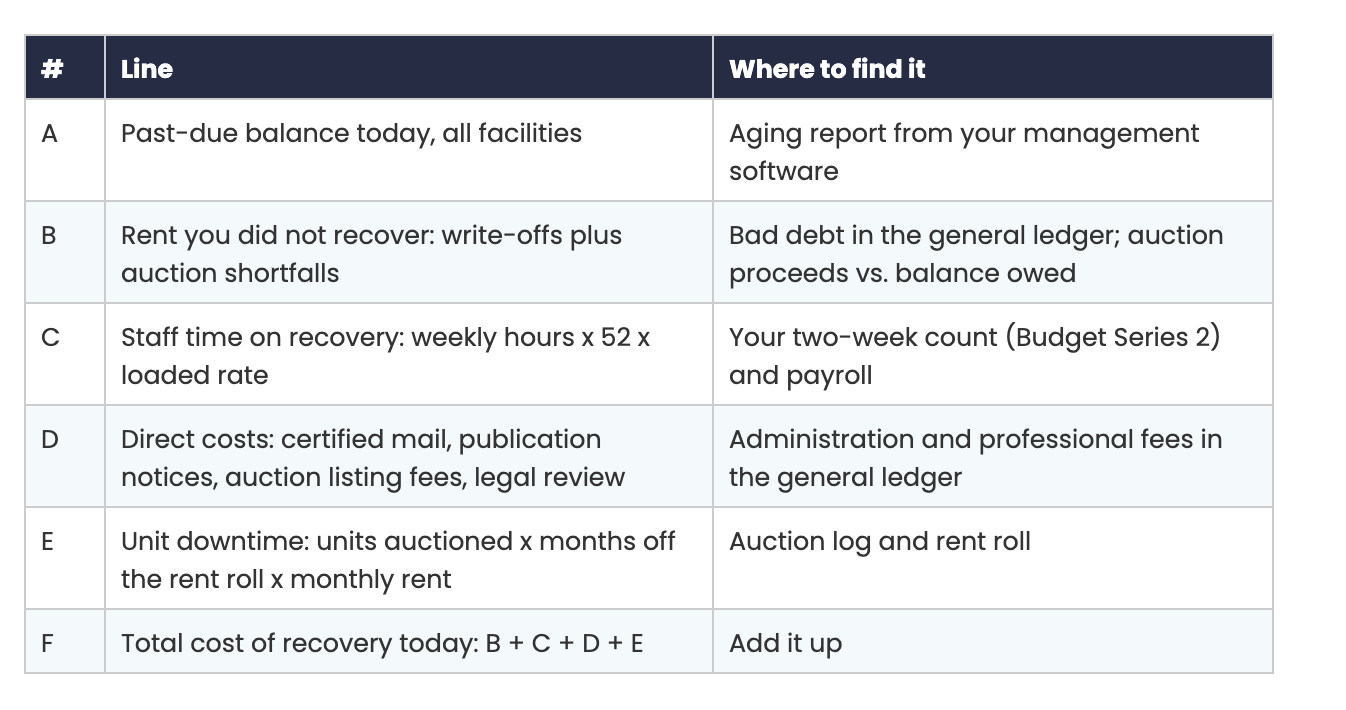
Line A isn't a cost. It's the earned revenue still on the table, and it's the number your 2027 plan should go after. Lines B through E are what recovery costs you now.
WHAT IT LOOKS LIKE FILLED IN
Here is an illustrative 50-facility portfolio. Use it to check the shape of your page, not as a benchmark:
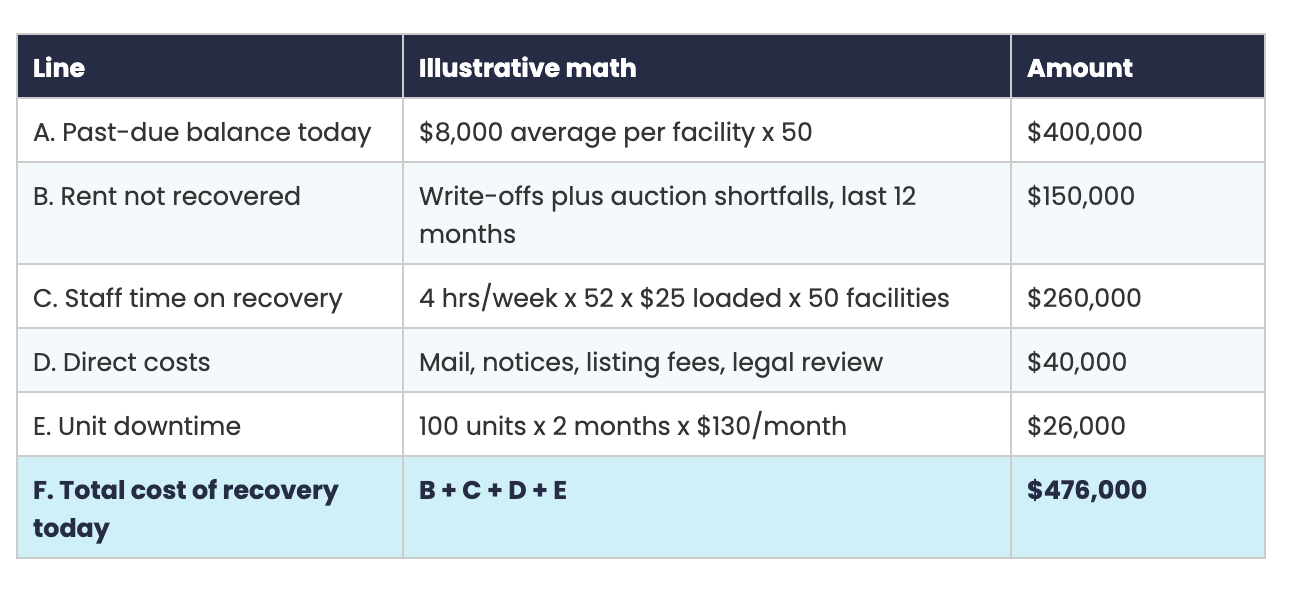
Even with modest assumptions, recovery costs this portfolio close to half a million dollars a year, before anyone counts the $400,000 still sitting in line A. None of it appears as one line in a typical budget.
“If I can save a facility $300, and we have 80 facilities—you do the math. That’s $24,000 a month. That’s basically a quarter of a million dollars a year. And it just starts with that little number.”
THE LINE TO ADD FOR 2027
Once the page is filled in, the budget conversation gets simpler. Next to your total, add one line for 2027 with two targets:
A recovery target: how much more of line A you will bring back, and how much faster.
A cost target: what lines B through E should look like when recovery runs as one process instead of four.
That's a plan finance can hold you to. It also changes the question from "what does a recovery platform cost?" to "what does recovery cost us now, and what should it cost?"
THE LINE THAT ISN'T ON THE PAGE
One cost doesn't fit on a worksheet until it happens: a missed notice, a deadline that slipped in a state you just entered, or a wrongful sale. Many operators who move recovery to a platform say that risk mattered as much as the money.
“It was never really about reducing delinquency for us, we were already diligent. It was about time. And about the liability, because the lien laws are changing more frequently than they used to.”

See How Your Operations Stack up…
Download the Self-Storage Operational Discipline Assessment to evaluate how well your current systems support disciplined operations.
PUT IT IN THE BUDGET
Ai Lean is the first intelligent recovery platform for self-storage, from day one to day done. It recommends who to reach, when and what to offer, sends lien notices on each state's timeline with a full audit trail, carries accounts straight into auction on any site or on BidHaven, and moves resolved units back toward available inventory. Your managers make the calls only a person can make. The platform carries the rest.
This series started with the case that your fastest 2027 revenue is rent you've already earned, then found the hours you're already paying for to recover it.
This article puts it all in one place. Fill it in, and bring it to the meeting.
Get Your 2027 Recovery Number
Bring your worksheet, or start from scratch. In a short review, our team will help you find what's recoverable, where it's leaking, and what it's worth in next year's budget.
Frequently Asked Questions
Q1: How do I build a delinquency budget for a self-storage portfolio?
Start by putting every cost of recovery on one page instead of leaving it spread across the P&L. Pull your current past-due balance, what you recovered and wrote off over the last 12 months, the staff hours spent on recovery, your direct lien and auction costs, and the rent lost while units sit in lien, auction and cleanout. Add them up to get what recovery costs you today. Then set two 2027 targets: how much more of the past-due balance you will recover, and how much less the process will cost.
Q2: What costs should be included in the cost of collections at a self-storage facility?
Include write-offs and auction shortfalls, the staff time spent on past-due accounts, lien notices and auctions, and direct costs such as certified mail, publication notices, auction listing fees and legal review. Also include unit downtime: the rent a unit doesn't earn while it moves through lien, auction, cleanout and inspection. Most of these sit in different places on a P&L, which is why the total is usually larger than anyone expects.
Q3: How do I calculate revenue lost to unit downtime after a storage auction?
Multiply the number of units that went to auction in the last 12 months by the average months each unit spent off the rent roll, then by your average monthly rent per unit. Count the time from when the unit stopped generating rent until it was rented again, including cleanout and inspection. If you don't track average rent per unit, the 2025 MSM/Newmark Expense Guidebook averages work out to roughly $130 a month, but your own rent roll will be more accurate.
Q4: Where does delinquency show up in a self-storage P&L?
In several places at once, which is why it rarely gets its own budget line. Write-offs show up as bad debt. Staff time sits in on-site and off-site management. Postage, publication and legal costs fall under administration. Units waiting on lien, auction and cleanout show up as lower occupancy and lost rent. Pulling these into one worksheet gives finance a single number to plan against.
Q5: How should I present collections costs to a CFO or ownership group?
Show the total cost of recovery today on one page, with each line tied to a source finance already trusts: the aging report, the general ledger, payroll and the rent roll. Then show one 2027 line next to it, with a target recovery rate and a target process cost. Keep the example numbers clearly labeled as your own and avoid industry averages where you have real data. A single page with traceable numbers is easier to approve than a slide of percentages.
Sources
MSM and Newmark, The 2025 Self-Storage Expense Guidebook (Table 2, Table 3, Table 10, definition of On-Site Management; 2,096 facilities) — modernstoragemedia.com — 2025
Continue Reading