Before You Hire Another District Manager, Read This

It usually starts in a budget meeting. The portfolio has grown, your district managers are stretched thin, and someone finally says what everyone's been thinking: we need another DM.
Maybe you do. But before you post that job, ask a harder question first: what are your current DMs actually spending their week on?
For a lot of multi-site operators, the honest answer is recovery work.
Chasing past-due accounts. Tracking lien deadlines across states. Prepping auction photos and paperwork. Following up when a winning bidder never shows. It's necessary work. It's just not the work you hired a district manager to do.
You might not have a headcount problem. You might have a recovery-work problem. And hiring doesn't fix that. It just spreads the same work across one more person.
WHERE YOUR MANAGERS' HOURS ACTUALLY GO
Recovery work has three traits that make it a quiet time sink for good people:
It's relentless. Every missed payment starts a clock, and the clock doesn't care how busy the week is.
It's deadline-driven and state-specific. Notice windows, publication rules and sale dates vary by state, and one miss can put a sale at risk.
It's repetitive. The same calls, the same letters, the same uploads, at every site, every month.
Put those together and the role slowly fills with tasks nobody planned for. Your DMs become part-time collections agents, part-time compliance clerks and part-time auction coordinators. The coaching, site visits and customer experience work they're actually great at gets squeezed into whatever time is left.
WHEN RECOVERY STOPS BEING THE BOTTLENECK
Crescendo Self Storage Management faced the growth version of this question. Here's how they describe what changed:
“We’ve grown from three locations to over 31 in just under five years, and AI Lean has been instrumental in helping us scale our operations efficiently while maintaining compliance across all our facilities.”
That's the math most operators skip. A new hire adds one person's worth of capacity. Taking repeatable recovery work off your managers' plates gives capacity back across the whole team, including the people you already know and trust. Growth stops automatically meaning another DM.
RUN THE MATH BEFORE YOU APPROVE THE REQ
A new district manager isn't just a salary. There's recruiting, ramp-up time, benefits, travel, and the very real risk that an overloaded role burns out the next person too. Before you sign off, answer three questions:
How many hours a week do your DMs spend on delinquency, lien and auction tasks? Ask them, and ask them to be specific.
How much of that work is repeatable and deadline-driven, rather than a true judgment call?
If that repeatable work disappeared tomorrow, would you still need the hire?
Gut check: if your answer to that last question is "probably not," you're about to pay a salary to do work a platform can handle.
There's a risk angle, too. When lien expertise lives in one or two people's heads, every vacation, resignation or new state becomes exposure. Hiring adds a person. It doesn't remove that single point of failure.
“…Now, the worry of meeting legal timelines, staying in front of changes in the state statues, and seamless integration with our online auction advertising have all gone to one source.”
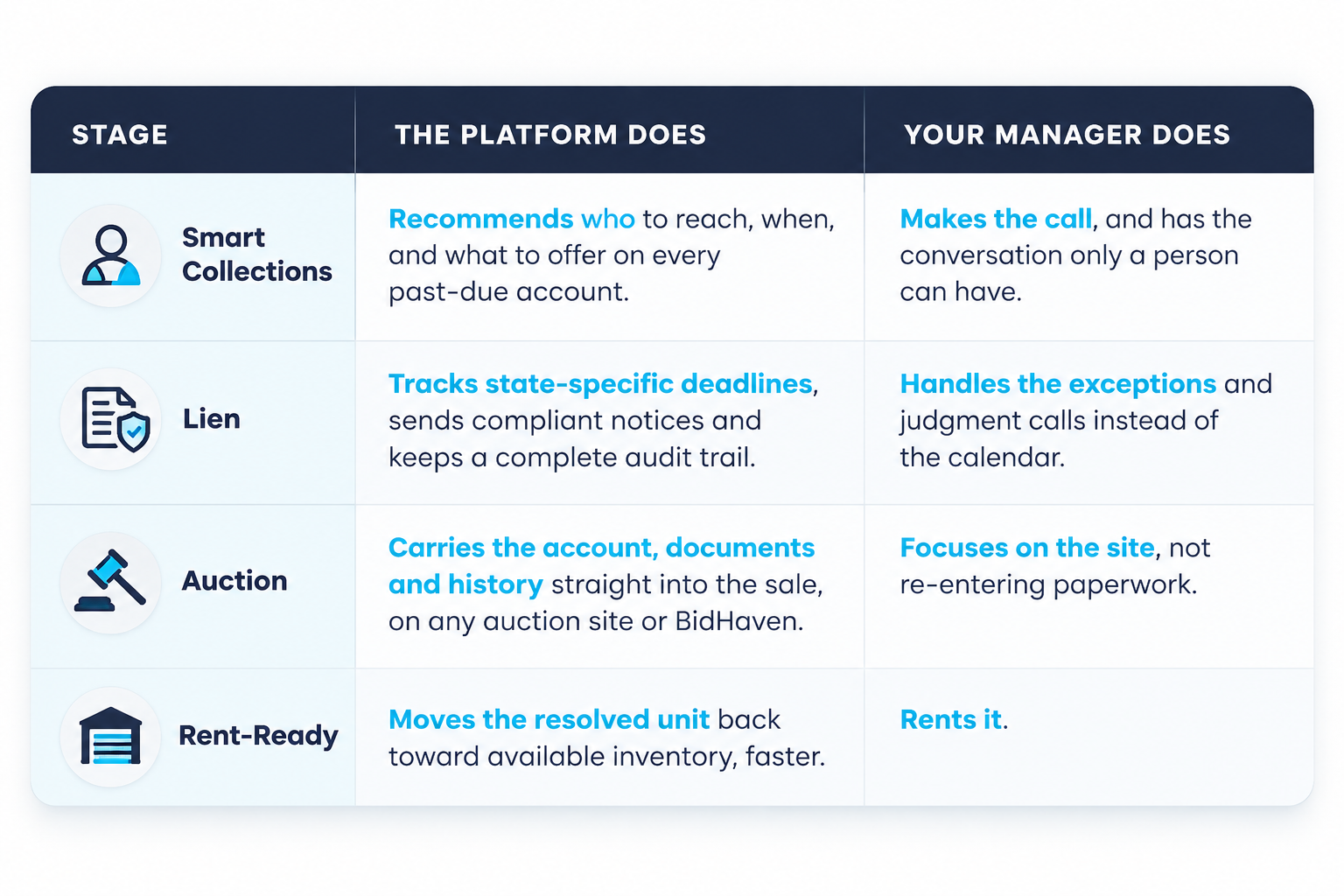
WHAT THE PLATFORM DOES. WHAT YOUR MANAGER DOES.
Ai Lean is the first intelligent recovery platform for self-storage. It runs the entire recovery lifecycle, from the first missed payment to a resolved, rent-ready unit, through one FMS connection. But the point isn't the technology. It's the split:
“Before Ai Lean, missed auctions and inconsistent practices were too common. With Ai Lean’s structured processes and regular follow-ups, Storage Star’s team has embraced a culture of accountability. Managers who once struggled with manual tasks are enjoying more time to focus on growth drivers like sales and customer service.”
WHEN YOU SHOULD STILL HIRE
To be clear: automation isn't a substitute for leadership. If your DMs are stretched because you're opening new sites, entering new markets or your teams need more coaching, hire. Those are exactly the jobs that need a person.
The goal is making sure that when you do add a district manager, they spend their week leading, not chasing paperwork. Hire for growth. Automate the grind.
BRING YOUR DM MATH TO THE SHOW
We'll be at Modern Storage Media’s The Show in Atlanta, November 4–6, at Booth #646. Bring your numbers. We'll walk through where your managers' hours are going and what Ai Lean can take off their plate, stage by stage.
Bring Your DM Math to MSM The Show Booth #646
Headed to The Show in Atlanta, Nov 4–6? Book 20 minutes with our team and see where your managers' hours could go instead. Not attending? We'll walk you through it online.
FREQUENTLY ASKED QUESTIONS
Q1: Should a self-storage operator hire another district manager or automate recovery work?
Start by measuring how much of your district managers' week goes to delinquency, lien and auction tasks. If a large share is repeatable, deadline-driven work, automating it can return enough capacity that the new hire isn't needed. Crescendo Self Storage Management, for example, credits Ai Lean with helping it scale from three locations to more than 31 while maintaining compliance across its facilities. If your managers are stretched by growth, new markets or coaching needs, a hire still makes sense, because those jobs need a person.
Q2: How much time do self-storage managers spend on delinquency and lien work?
It varies by portfolio, state mix and process, so the most reliable answer comes from asking your own managers to track it for a few weeks. Operators using Ai Lean report meaningful time returned: Ai Lean customers see 15 to 30% of manager and district manager time returned, and FreeUp Storage's district manager reports sites saving between 2 and 9 hours each time. Those results suggest recovery work is often a bigger share of the week than leadership assumes.
Q3: What parts of self-storage delinquency and lien management can be automated?
Much of the repeatable work can be: identifying which past-due accounts need attention, timing outreach, generating and sending state-compliant lien notices, tracking deadlines, keeping an audit trail, and carrying account documents into the auction. An intelligent recovery platform like Ai Lean connects to your facility management software and runs this lifecycle from the first missed payment to a rent-ready unit. Judgment calls, tenant conversations and exceptions stay with your team.
Q4: Will automation replace self-storage site managers?
It shouldn't, and the best approach doesn't try to. Ai Lean's model is to arm managers, not replace them: the platform handles repetitive, deadline-driven recovery tasks, and managers make the calls that need a person. Customers describe the result as more time for sales, customer service, training and site standards. Automation works best as leverage for your team, not a substitute for it.
Q5: What is Smart Collections?
Smart Collections is the collections stage of Ai Lean's intelligent recovery platform. It recommends who to reach, when, and what to offer on each past-due account, so operators can recover more, sooner, before an account becomes a lien. Managers stay in control of the conversation and the decision. It's one part of a lifecycle that also covers lien compliance, auctions (including the BidHaven marketplace) and returning units to rent-ready inventory.
Continue Reading