Sentinel Storage Was Handling It Well. Here's Why They Brought In Ai Lean.
Already Lean, Still Better
How Sentinel Storage reclaimed 30% of its regional managers’ time — and moved compliance risk off its own shoulders — across 22 sites and four states.
| Company | Sentinel Storage — family-owned, multi-state self-storage operator |
| Footprint | 22 locations across Delaware, Pennsylvania, Maryland, and New Jersey |
| Went Live | Late summer 2025 (two-phase rollout; fully ramped by early 2026) |
| Starting Point | Delinquency already low (~2.5%) — the goal was time and risk, not recovery |
| Initial Result | ~30% of each regional manager’s time recovered Confidence that compliance is handled |
Sentinel Storage is not the operator most people picture when they think about a delinquency problem.
The family-owned operator runs 22 locations across Delaware, Pennsylvania, Maryland, and New Jersey, and its delinquency was already sitting around 2.5%. They are disciplined and well run.
Their delinquency was low enough that the usual pitch, “we’ll bring your delinquency down,” simply didn’t apply. Sentinel had been running its own lien and auction process for years, in-house, and running it well. They let it go anyway. Why a well-run operation would give up something it had handled competently for that long is the whole point of this story.
A TIGHT SHIP WITH A HIDDEN COST
The problem wasn’t the numbers. It was what keeping those numbers healthy demanded of the people responsible for them.
Sentinel’s lien and auction process ran almost entirely on the backs of its regional managers. Lien work ate into nearly every week of the month: file reviews the week before each auction, then two to three days of live auctions, with managers driving between six and seven sites in a single day. They would be lifting doors, running the sales, taking payments, writing receipts, and clearing ledgers in the FMS. Some sites had remote sections that added even more drive time.
Layered on top of that was compliance. Four states meant four sets of lien laws, rules that change more often than they used to. Staying current was constant background anxiety, and the process was manual and multi-touch, where a single missed step could force a restart or create exposure. The team was diligent enough to avoid trouble, but that diligence had a cost: they were personally absorbing the risk, every single cycle.
The auction process was never value-added work for Sentinel’s staff. It kept the business compliant, but it pulled their best operators away from the things that actually build a storage company — training, customer experience, and site standards.
WHY DOING IT THEMSELVES STOPPED BEING WORTH IT
Christine Moritz, Sentinel’s Director of Operations, had spent years looking for something that could take the whole process off her team’s plate. The options she found always handled a piece of it — and then handed the rest back. That was the sticking point. A partial solution still left Sentinel doing the parts that made the change not worth the trouble. What she wanted wasn’t a better slice of the process. She wanted the whole thing gone.
WHAT CHANGED WITH AI LEAN
Ai Lean took the entire lien-to-auction cycle — not a slice of it — off Sentinel’s team, and paired that automation with legal oversight and a dedicated account manager.
End-to-end, with minimal oversight. Ai Lean runs the process from start to finish. For a team that had rejected every prior option for leaving gaps, the difference was that there were no gaps to fill — the work simply moved.
Compliance as a backstop. Ai Lean monitors state-specific lien-law changes across all four states. Christine still stays close to the legislation — she’s active in it — but she no longer carries it alone. If a requirement changes, there’s a second set of eyes behind her, and the liability for getting it right shifts to a partner built to carry it.
"My confidence on the compliance side has jumped.
If there's ever an error, it doesn't fall on our shoulders the way it used to."
— Erick Maurer, Regional Manager, Sentinel Storage
Online auctions replace the drive. Sentinel’s managers had resisted moving auctions online — they valued the relationships they’d built with bidders in person. What changed their minds wasn’t a sales pitch, it was hearing from other Ai Lean customers, during reference calls, how much they preferred the online model. With that buy-in, the site-to-site auctions that demanded driving across four states simply ended.
Advisory value, not just software. Early on, Ai Lean flagged a Sentinel policy — accepting partial payments and making one-off deals to postpone a sale — as out of step with industry practice, and explained why. Sentinel moved to an all-or-nothing standard. It removed a recurring headache: no more back-and-forth tracking who paid what, and no more chasing the second half of a payment before a sale.
A partner, not a vendor. Full transparency in the platform — every step of every account visible to managers — built confidence at the ground level. Sentinel’s managers picked the system up quickly and embraced it with no pushback, and the relationship settled into a true partnership rather than a service contract.
“It’s really a no-brainer. With Ai Lean you’re removing the liability, and you’re giving your staff their time back to redeploy in more impactful ways.”
THE RESULTS
The change showed up first, and most clearly, in time.
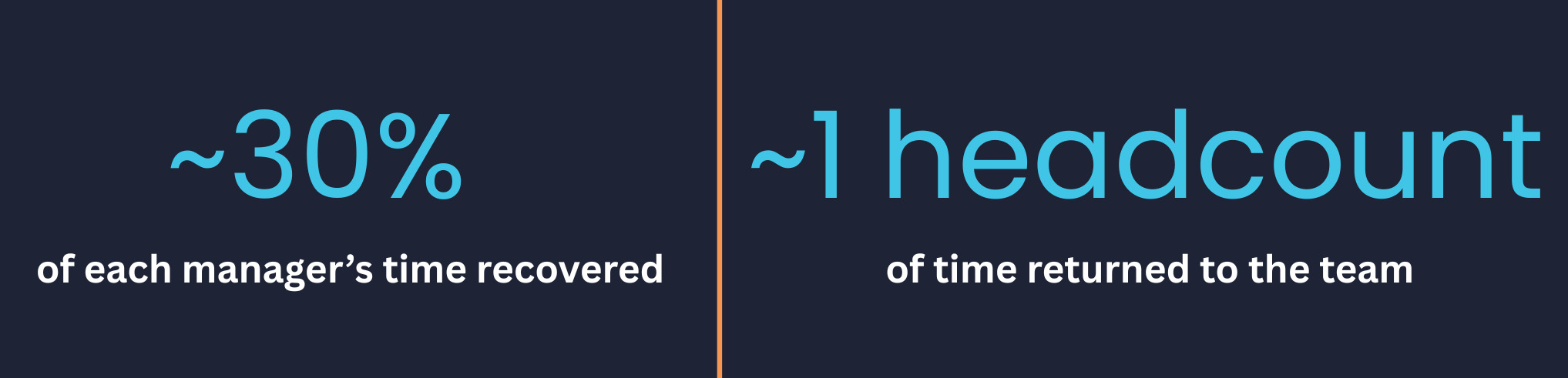
Time reclaimed and redeployed.
Each of Sentinel’s regional managers got roughly 30% of their time back — a figure both Christine and her managers independently confirmed. That time didn’t evaporate into more of the same; it was redeployed. Managers now spend real time developing their teams — running new-hire and spot training — and investing back into the properties. Sentinel reports being fully staffed for the longest stretch in memory, and leadership has been freed to focus on modernizing other parts of the operation.
Compliance confidence and liability transfer.
For an operator whose delinquency was already low, this is where the real value landed. Confidence on the compliance side jumped: if an error ever occurs, it no longer falls on the team’s shoulders the way it used to. The rigor actually deepened, too. Edge cases that used to live in the background, like how alternate contacts are documented, got pulled to the forefront and handled at a higher standard. The process didn’t just get easier; it got tighter.
A quieter win on chronic late-payers.
Because Ai Lean moves the lien timeline earlier in the month than Sentinel’s old cadence, it tightened up on the tenants who had learned to game the previous rhythm — going into lien, paying just enough to get out, and waiting for the next cycle. Delinquency was never the reason Sentinel signed on, but trimming that chronic pattern was a welcome side-effect.
A smooth rollout, strong adoption.
Sentinel rolled out in two phases across all 22 sites. The team’s hands-on involvement in implementation made the difference, and managers eagerly adopted the platform. Their advice to peers is simple: trust the process and give it time to roll out. The benefits show up almost immediately.
"Trust the process and give it time to roll out.
You’ll see the benefits almost immediately, like we did."
— Jaclyn Megginson, Regional Manager, Sentinel Storage
THE LESSON FOR OPERATORS WHO THINK THEY DON’T NEED THIS
Sentinel didn’t come to Ai Lean broken.
They came already in good shape, and still found the math to work to their advantage. Handing off work that was never value-added gave their best people their time back, sharpened their compliance posture, and moved the liability off their own shoulders and onto a partner built to carry it.
For operators who assume that low delinquency means they don’t need help, Sentinel is the proof that the value isn’t only in recovery. It’s in time, in risk, and in what a disciplined team can accomplish once the non-value-added work is finally off their plate.
“You have to look at Ai Lean as a partner, not a vendor. If they’re not doing well, we’re not doing well. We only succeed together.”
See what your lien process is actually costing.
A 20-minute workflow audit shows you the hours and the legal risk hiding inside your current process — no delinquency problem required.
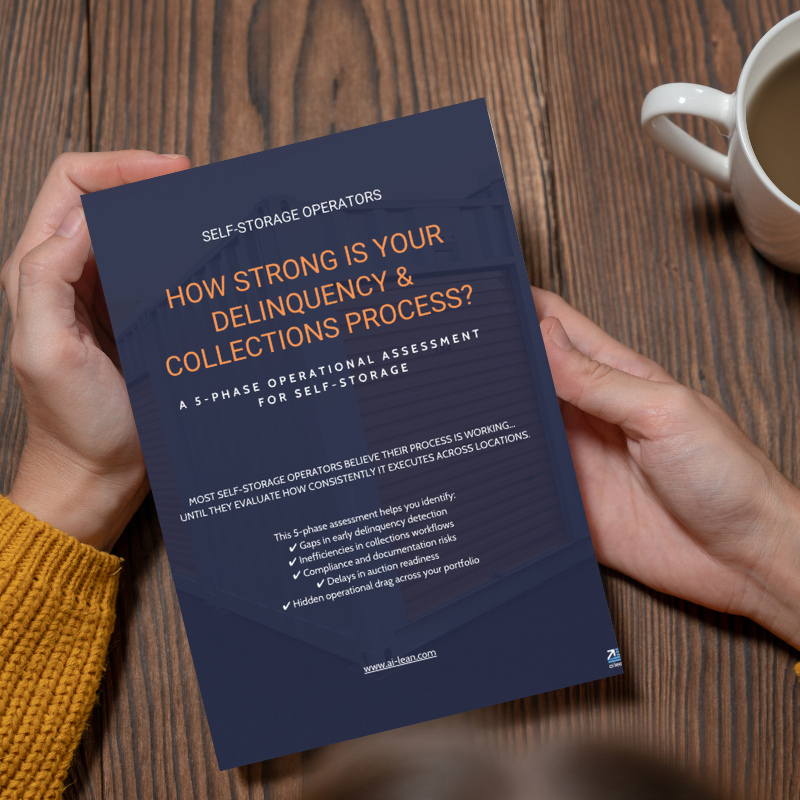
Want to Evaluate Your Own Operations?
Download the Self-Storage Operational Discipline Assessment to evaluate how well your current systems support disciplined operations.
Continue Reading