How to Sell Delinquency Automation to Your COO

THE BUSINESS CASE SERIES | POST 3 OF 3
You’ve done the audit. You’ve built the numbers. Here’s how to walk into that room and get a yes!
Here’s the situation a lot of operations leaders find themselves in:
You’ve worked with a vendor. You’ve seen the demo. You understand what this would do for your portfolio. You’ve done the math. And now you need to go to the higher-ups and convince someone who wasn’t in the room — who hasn’t seen what you’ve seen! — to approve it.
This is one of the harder positions to be in…
Not because your case is weak, but because you’re translating an operational reality into a financial and strategic decision for someone who is going to hear it once, ask a few questions, and make a call.
This post is about making that translation as clean as possible so you can get a “yes”!
The Mindset Shift Before You Walk In
Stop thinking of this as a pitch. You’re not selling software.
You’re presenting a business problem with a documented financial impact, and proposing a solution with a clear ROI.
That’s a very different conversation — and it requires a different posture.
You’re not advocating for a vendor. You’re advocating for operational discipline and protecting the company’s revenue.
If you walk in with that framing, the objections change.
“I’m not sure about this vendor” becomes less relevant when the conversation is really about “we have a six-figure problem in our delinquency pipeline.”
How to Open the Meeting
Lead with the problem, not the solution. This is the most common mistake — walking in with “I found this platform that could...” instead of “I’ve been looking at our delinquency numbers and I want to show you something.”
A strong opening sounds like:
“I’ve been auditing our delinquency process across our locations, and I want to share what I found. We have [X units] currently delinquent, representing roughly $[Y] in revenue sitting in our pipeline.
We’re spending approximately [Z hours] per week managing this manually, which is about $[labor cost] annually.
And I think our compliance exposure is higher than we’ve even accounted for. I want to walk you through what I think we could do about it.”
That’s it.
Problem established.
Numbers on the table.
Recommendation incoming.
You’ve created the expectation of a solution without leading with the vendor.
The Three-Part Case
Structure your case in this order, and don’t skip ahead:
1. The cost of the current state
Your audit data: revenue in delinquency, labor cost, compliance risk.
Make the problem bigger than the solution cost before you ever mention the solution cost. This is the most important sequence in the meeting.
2. What’s changed in the market
Operators at your scale have been moving to automated delinquency and lien management. This isn’t a cutting-edge experiment — it’s quickly becoming the operational baseline for anyone running 10+ locations who wants to compete with REIT-managed properties.
Framing this as “catching up to the standard” is often more persuasive than “getting ahead of the curve.”
3. The specific ask with a specific ROI
Don’t ask for general approval to “explore options.” Come in with a specific solution, specific cost, and a clear payback framing:
“We can address this for $X/month. Given our current recovery rate and labor spend, we expect payback within 60–90 days based on what comparable operators have achieved.”
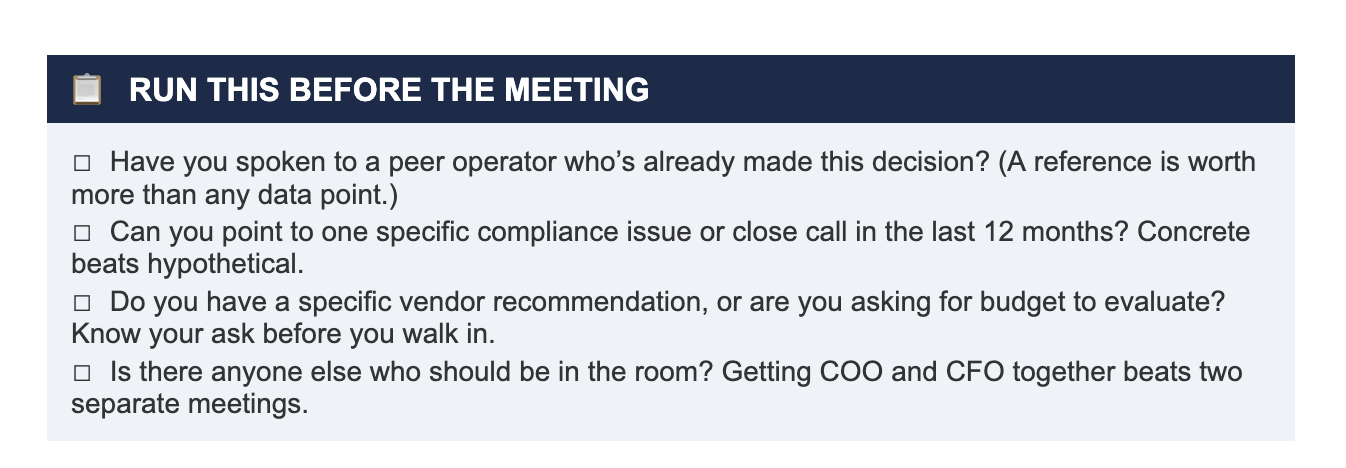
💬 WHAT THEY’LL ASK
“Why now? We’ve managed this ourselves.”
“We have, and we’re managing — but the risk profile is different at this scale. Manual processes that worked at 5 locations carry different compliance exposure at 20+. The math also changed: we’re spending more in labor than the solution costs.”
“What if we just hire someone to manage this?”
“That’s what most operators considered before running the numbers. A dedicated collections person runs $50,000–$65,000 in salary. And is one person really enough? But this solution comes with a turnover risk or state compliance gaps.”
“What does implementation look like?”
“The onboarding process is 60–90 days. Operators have gone from fully manual to automated in that window. One team went from over $1M in bad AR to $120K within 90 days, and freed up more than 500 hours of staff time per month. It’s a real transition with real support behind it.”
“What’s the downside if this doesn’t work?”
“We’re at risk either way. The difference is that today we’re manually managing compliance across multiple states, and one wrongful sale claim is more expensive than a year of this solution. We’re not eliminating risk — we’re moving to a lower-risk execution model.”
What to Leave Behind
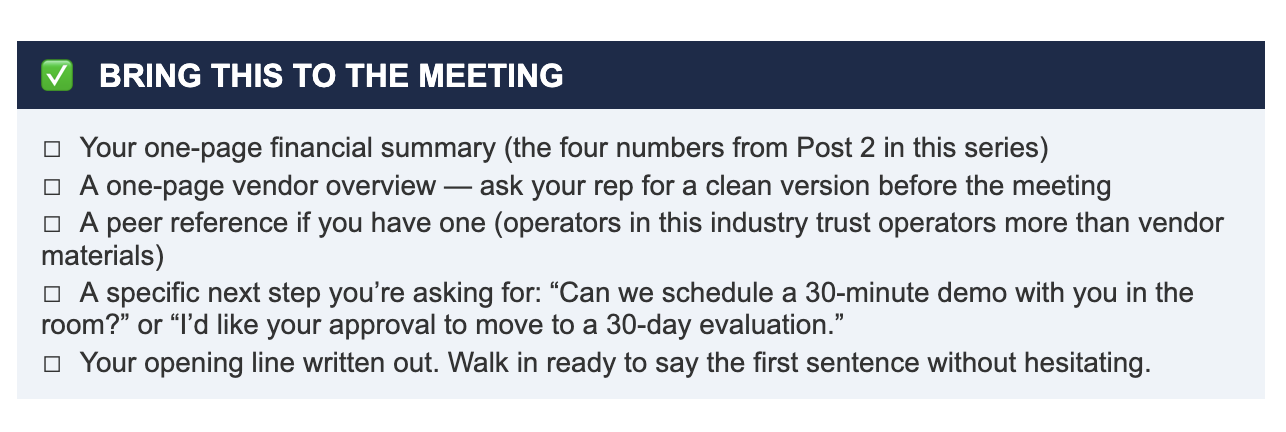
The leave-behind matters as much as the meeting itself. Don’t walk out empty-handed or promise a follow-up email with “more information.”
That’s where decisions go to die.
Leave the room with something in their hands and a specific next step agreed upon.
One More Thing
The operators who get this approved don’t have better numbers than the operators who don’t.
They have a cleaner story.
If you can connect the operational reality you live in every day to the financial language the people above you use to make decisions — you’ve done something most operations leaders never crack.
The math is already sitting in your portfolio. The problem is real and it’s documented. You just have to tell the story in the right order.
Want to walk into that meeting with real numbers — not estimates?
Ai Lean can help you build a portfolio analysis for your specific operation in 30 minutes, so you go to management with data, not just gut feeling and a good idea.
The Business Case Series
Part 1: How to Turn a Gut Feeling Into a Budget Conversation
Frequently Asked Questions
Q: How should an operations manager present a technology investment to a COO or CFO?
A: Lead with the problem, not the solution. Open by presenting documented financial impact — trapped revenue, labor cost, compliance risk — before mentioning any vendor. Structure your case as: cost of current state, what the market is doing, then your specific ask with ROI.
Q: What’s the most common mistake when pitching internal technology investments?
Leading with the vendor or product instead of the business problem. Decision-makers respond to financial impact, not feature lists. Establish the cost of inaction before you introduce the solution — this completely changes how the conversation lands.
Q: How do I handle objections when pitching delinquency automation to ownership?
Prepare for four common objections: “we’ve managed this ourselves,” “why not hire someone,” “what does implementation look like,” and “what if it doesn’t work.” Each has a clean answer when you’ve done the pre-meeting numbers work from the earlier posts in this series.
Q: What should I leave behind after a budget meeting for technology investment?
A one-page financial summary with specific numbers, a brief vendor overview (one page), a peer reference if available, and a clear proposed next step. Don’t leave without a specific action agreed upon — open-ended follow-ups are where budget decisions stall.
Q: How long does it take to get ROI from delinquency automation in self-storage?
Most operators see meaningful results within 60–90 days. Storage Stars reduced bad AR from over $1 million to $120,000 within 90 days of going live, freed up more than 500 hours of staff time per month, and brought delinquency below 2%.
Continue Reading