The Business Case Your CFO Will Actually Read

THE BUSINESS CASE SERIES | POST 2 OF 3
How to translate delinquency chaos into a one-page financial summary that gets budget approved.
CFOs and owners speak a different language than operations leaders.
You speak in processes, timelines, and workflows.
They speak in NOI, payback periods, and line items.
This isn’t a problem … it’s actually an advantage.
If you can translate what you already know about your delinquency process into their language, you become the person in the room with the clearest picture of a problem most ownership groups have yet to quantify.
This post gives you the framework to build that one-pager. Not a 20-slide deck. Not a whitepaper. One page, four numbers, a recommendation.
Why One Page Wins
The goal isn’t to explain everything. The goal is to make the problem undeniable and the solution obvious in the time it takes to read a menu.
Ownership groups and CFOs make dozens of decisions per month. The proposals that get funded aren’t necessarily the most comprehensive — they’re the ones where the math is clean and the risk of NOT acting is clear.
Your job in this document: Make inaction look more expensive than action.
The Four Numbers That Do the Work
Number 1: Revenue Trapped in Delinquency
Delinquent units × average monthly rent =
Monthly revenue in your delinquency pipeline
This is revenue that exists but isn’t being collected — and in many cases, isn’t being actively recovered because the process to recover it is too slow or too manual. For a 20-location operator running 3–5% delinquency, this number is often $40,000–$100,000+ per month.
Number 2: Annual Labor Cost of the Current Process
Weekly hours on delinquency tasks × $25/hr × 52 weeks =
Annual hidden labor cost
This is the invisible payroll line. Most operators don’t think of delinquency management as a labor cost — but it is. Forty hours per week across your portfolio on manual collections tasks equals roughly $52,000 in annual labor, spent on a process that could be largely automated.
Note: These labor hours can be redeployed to customer-facing, revenue-generating activities or facilities management.
Number 3: Compliance Exposure
This one doesn’t have a clean formula, but it belongs in the document. One successful wrongful sale claim typically runs $10,000–$100,000+ in legal fees and settlement costs. If your lien process has manual steps, missed deadlines, or inconsistent execution across locations, this risk is real and ongoing. 70% of self-storage legal disputes involve improper notification during the lien process.
You don’t need a precise number. You need to name the risk category. That’s enough to change the conversation.
Number 4: The ROI Framing Sentence
“We are currently leaving [Number 1] in uncollected revenue every month, while spending [Number 2] annually to manage a manual process that carries [Number 3] in compliance risk. Automating this workflow addresses all three.”
That’s a CFO sentence.
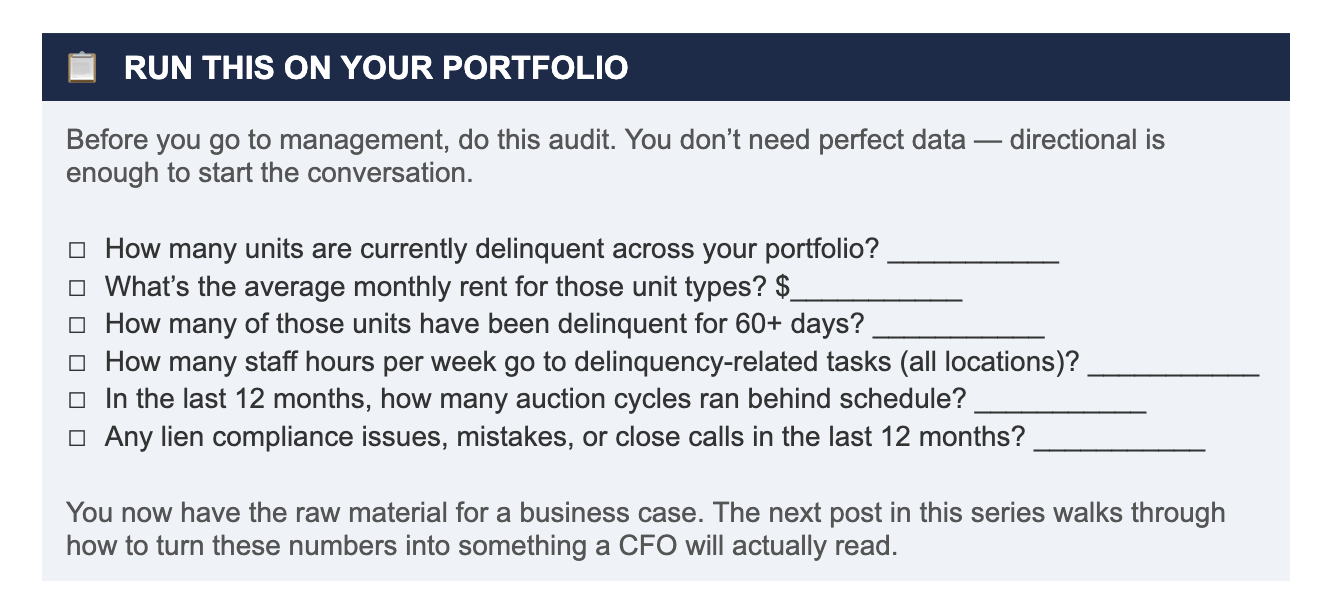
📋 YOUR NUMBERS WORKSHEET
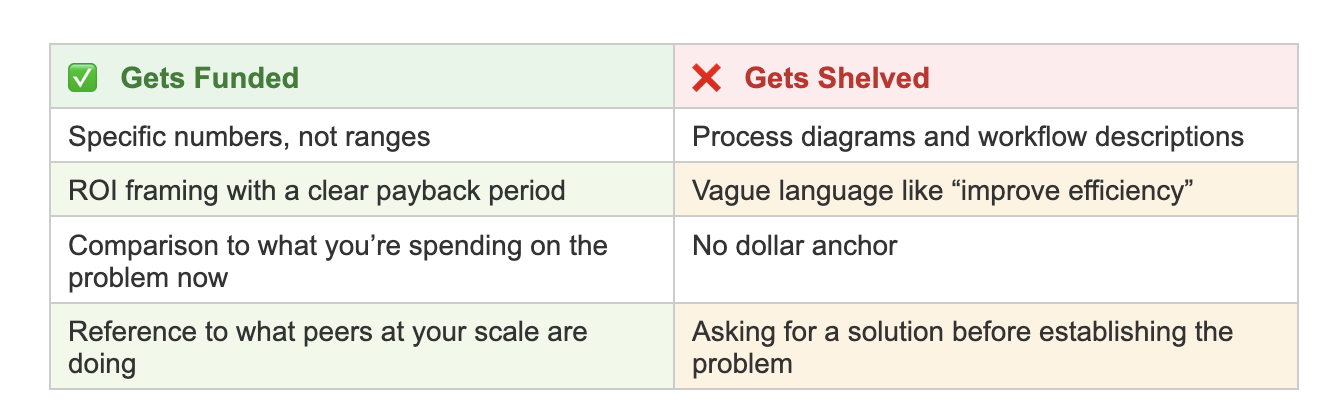
What Makes This Land vs. What Gets It Shelved
💬 WHAT THEY’LL ASK
“What’s the payback period?”
Calculate it before you walk in: if the solution costs $X/month and you’re currently losing $Y/month to slow recovery and labor inefficiency, the payback math is straightforward. Most operators find payback inside 60–90 days.
“What if we just tighten our internal process instead?”
Acknowledge it honestly: “We could — and we’ve tried. The challenge is state-by-state compliance requirements, staff turnover, and inconsistent execution across locations. The risk doesn’t go away, it just moves around.”
“Is this a ‘nice to have’ or a real operational need?”
Answer with the compliance angle: “The lien process is legally prescribed. The question isn’t whether we follow it — we have to. The question is whether we’re following it correctly and consistently enough to protect the company.”
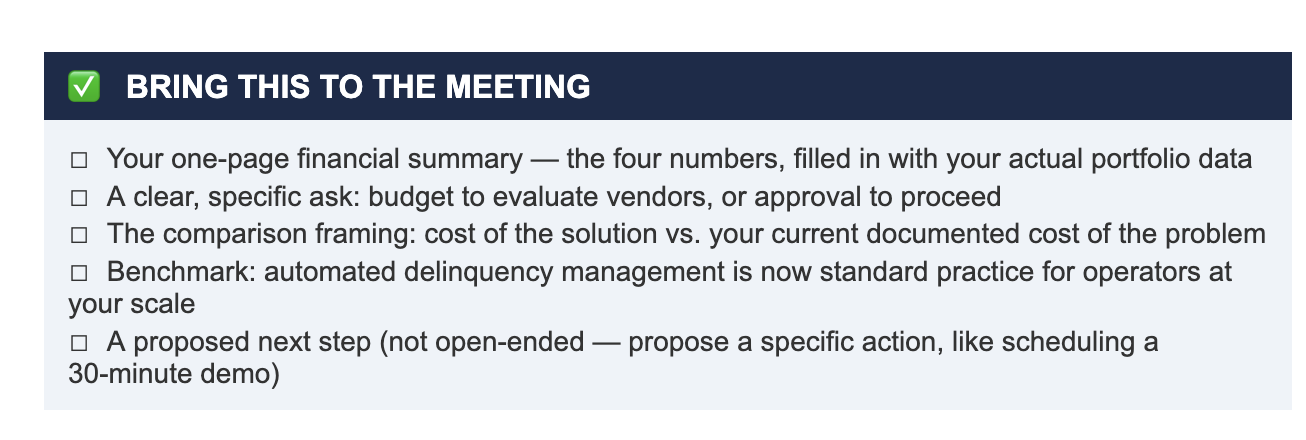
Next in this series: How to Sell Delinquency Automation to Your COO — the meeting itself, the opening, the objections, and what to leave behind.
Want the numbers model pre-built for your portfolio?
Ai Lean can run a portfolio analysis and give you real figures — not estimates — in 30 minutes.
The Business Case Series
Part 1: How to Turn a Gut Feeling Into a Budget Conversation
Frequently Asked Questions
Q: What financial numbers should I include in a business case for delinquency automation?
A: The four most persuasive numbers are: (1) monthly revenue trapped in delinquent units (delinquent units × avg monthly rent), (2) annual labor cost of manual collections workflows, (3) compliance exposure from the lien process, and (4) an ROI framing that compares solution cost to current documented losses.
Q: How do I calculate the ROI of delinquency automation for self-storage?
A: Compare the monthly cost of the solution against the sum of recoverable revenue from delinquent units and current labor spend on manual tasks. Most multi-location operators find payback inside 60–90 days. One operator reduced bad AR from $1M to $120K within 90 days.
Q: What’s the typical annual labor cost of managing delinquency manually?
A: For a 10-location portfolio with staff spending roughly 20–40 hours per week on collections tasks, the annual labor cost runs $25,000–$52,000 — often more than the annual cost of an automated solution. This figure typically surprises operators who haven’t tracked it explicitly.
Q: How do self-storage operators justify technology investments to owners?
A: The most effective approach is framing technology as addressing a documented financial problem, not as a software purchase. Build a one-page summary with specific numbers: trapped revenue, labor cost, compliance exposure. Make inaction look more expensive than the investment.
Q: How much compliance risk does manual lien processing create for self-storage operators?
Significant. Research shows approximately 70% of self-storage legal disputes involve improper notification during the lien process. A single wrongful sale claim typically generates $10,000–$100,000+ in legal and settlement costs — often more than a year of automated compliance coverage.
Continue Reading