How to Turn a Gut Feeling Into a Budget Conversation

THE BUSINESS CASE SERIES | POST 1 OF 3
A practical guide for operations leaders who already know something’s broken, and need to show the numbers.
You already know.
You know it in the monthly collection calls that run long. You know it in the district manager spending two days a month on auction prep instead of visiting properties. You know it in the units that should be turning over but aren’t, because the lien process fell behind and nobody caught it until the following cycle.
The problem isn’t knowing. The problem is that “I think our delinquency process is broken” doesn’t get a line item in the budget.
What gets a line item is a number.
Specifically, a number that makes management say “wait — that much?”
This post is about getting to that number.
What You’re Actually Looking At
Most operators track delinquency rate. Some track bad debt write-offs. Very few track the full cost of how the problem is actually being managed — and that’s where the real money is hiding.
There are three places to look:
1. Revenue that’s stuck, not lost
Delinquent tenants aren’t just non-paying…
They’re occupying units you can’t re-rent. At current street rates, every occupied-but-delinquent unit is a double hit: you’re not collecting rent, and you can’t rent it to someone who would pay. This is recoverable revenue, not a write-off — but only if your process is fast enough to actually recover it.
2. Labor that’s invisible
How many hours per week does your team spend on delinquency-related tasks? Phone calls, certified mail prep, uploading photos to auction sites, double-checking lien timelines, following up on notices? Most operators have never added this up. When they do, the number is usually somewhere between “uncomfortable” and “alarming.” A customer of ours recently noted that her team has been wasting over 30% of their time on these tasks!
3. Risk that’s off the books
Every missed or delayed statutory step in the lien process is potential liability. One wrongful sale claim can wipe out years of collections revenue. This one is harder to put a number on, but it belongs in the conversation.

Want to Evaluate Your Own Operations?
Download the Self-Storage Operational Discipline Assessment to evaluate how well your current systems support disciplined operations.
Translating Operational Pain into Owner Language
Here’s the translation key that matters most:
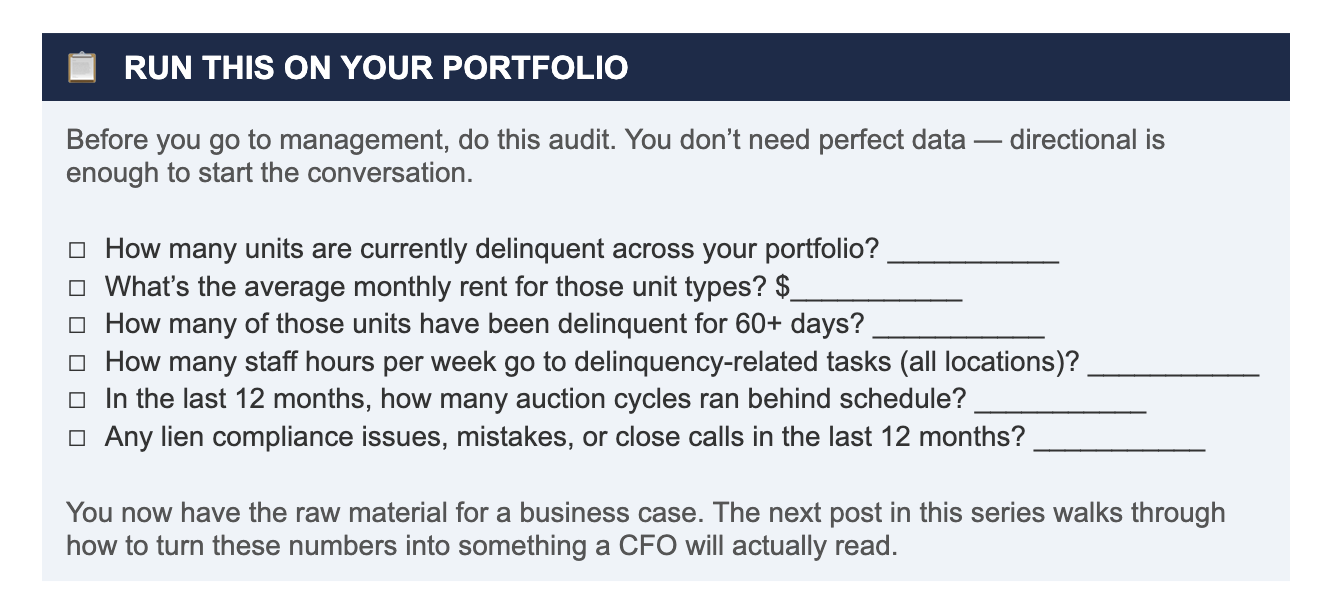
Delinquent units × average monthly rent = Revenue trapped in your delinquency pipeline
Staff hours per week × hourly cost × 52 = Annual labor cost of your current process
Those two numbers alone — built from the audit above in under 20 minutes — typically reveal something in the range of six figures of combined impact for a portfolio of 10+ locations.
One operator managing 51 locations described their situation this way: they knew the process was inefficient, but they’d never added it up. When they did, the number made it easy to have the budget conversation.
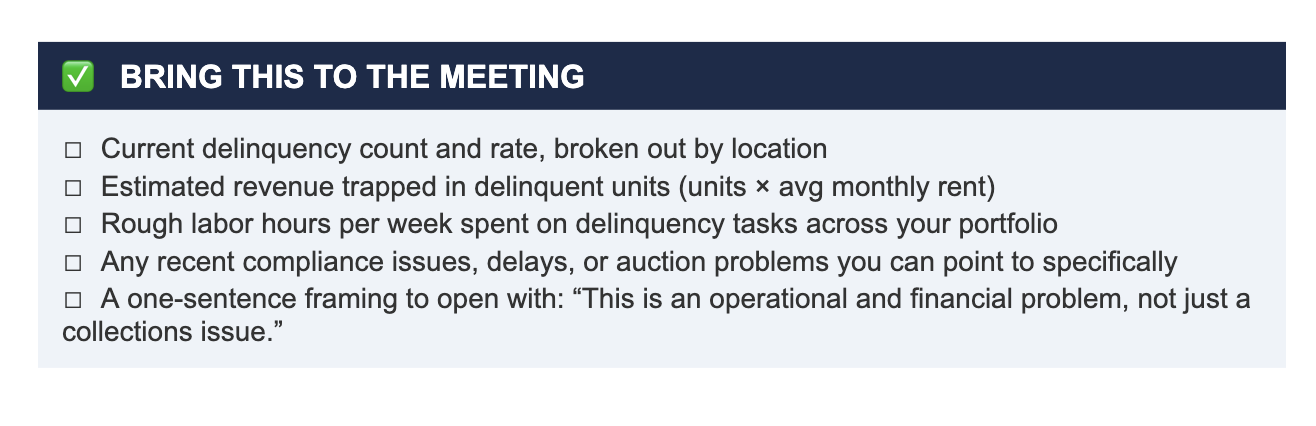
That’s exactly where you want to be when you walk into that room.
💬 WHAT THEY’LL ASK
When you bring this to your COO or owner, expect these questions. Here’s how to answer them.
“Isn’t this what we’re already paying for through our PMS?”
Property management software manages tenants. It doesn’t automate lien workflows, enforce statutory deadlines, or create audit-ready documentation. Most PMS tools stop at the notice — what happens after that is still manual.
“How do we know the problem is big enough to justify the cost?”
Ask them to look at two numbers with you: the revenue trapped in current delinquency, and the hours your team is spending on a process that could be automated. The cost of doing nothing compounds every month.
“Can’t we just fix the process internally?”
You can try — and it’s worth saying so honestly. But inconsistent execution across locations, state-by-state compliance requirements, and staff turnover make internal fixes fragile. The question isn’t whether it can be done manually. The question is whether it should be.
Next in this series: The Business Case Your CFO Will Actually Read — how to turn your audit numbers into a one-page financial summary that gets budget approved.
Want to see what this looks like in practice?
The Storage Stars team had an 80% improvement in delinquency rates (reduced to under 2%) and freed up 500+ hours of staff time per month…
All within 90 days of automating their delinquency process!
Book a demo to see what the numbers look like for your portfolio.
ai-lean.com/demo
The Business Case Series
Part 1: How to Turn a Gut Feeling Into a Budget Conversation
Frequently Asked Questions
Q: How do I calculate the cost of delinquency in my self-storage portfolio?
A: Start with two numbers: delinquent units multiplied by average monthly rent (revenue trapped in your pipeline), and weekly staff hours spent on collections tasks multiplied by hourly cost and 52 weeks (annual labor cost). Together these typically reveal six-figure impact for portfolios of 10+ locations.
Q: What’s included in the true cost of self-storage delinquency?
A: The full cost includes three categories: revenue trapped in occupied-but-delinquent units that can’t be re-rented, the hidden labor cost of manual collections workflows, and compliance exposure from missed or delayed statutory steps in the lien process.
Q: How do I make the case for delinquency automation to my COO or CFO?
A: Lead with the problem, not the solution. Run a quick audit to quantify trapped revenue and labor costs, translate those into financial language, and frame the conversation as an operational and financial problem rather than a software purchase.
Q: Does my property management software handle lien compliance?
A: Most property management systems handle tenant records and basic billing, but stop short of automating lien workflows, enforcing state-specific statutory deadlines, or generating audit-ready documentation. The post-notice process is typically still manual.
Q: How long does it take to see results from delinquency automation in self-storage?
A: Based on operator experience, meaningful results typically appear within 60–90 days of implementation. Storage Stars, for example, reduced bad AR from over $1 million to $120,000 within 90 days of going live with automated delinquency management.
Continue Reading