Why Operational Discipline Beats Headcount in 2026
How the strongest operators are scaling without hiring their
way into lower margins
For years, the default response to operational strain in self-storage was simple: hire.
More locations meant more managers.
More units meant more oversight.
More complexity meant more people to manage it.
That approach worked when labor was easier to find, margins were forgiving, and growth covered inefficiency.
In 2026, that equation no longer holds.
Executive Summary
As labor costs rise and margins tighten, adding headcount is becoming an increasingly expensive way to solve operational problems. In 2026, high-performing self-storage operators are discovering that operational discipline — not additional staff — is the most effective way to scale.
Consistent processes, system-enforced execution, and reduced variability allow teams to do more without burning out people or eroding margin.
This article is the last in our series The 2026 Operational Reality Series, where we examine how self-storage operators are adapting their operations to succeed in a tighter, more disciplined market.
Why Hiring Is No Longer the Easy Answer
Adding people feels like progress.
Problems get attention. Tasks get owned. Bandwidth increases — at least temporarily.
But headcount comes with compounding costs:
Higher payroll and benefits
Longer onboarding and training cycles
Increased management overhead
Greater variability in execution
More people don’t automatically create better outcomes. In many cases, they simply spread inefficiency across a larger team.
In a normalized market, that inefficiency shows up quickly on the bottom line.
The Real Constraint Isn’t Capacity — It’s Consistency
Most operational issues don’t stem from a lack of effort or staffing.
They stem from inconsistency.
Different locations execute processes differently. Timelines vary. Exceptions get handled ad hoc. Knowledge lives in people’s heads instead of systems.
Adding headcount doesn’t fix that.
It often amplifies it.
When execution depends on who is working, performance becomes unpredictable — no matter how many people you hire.
How Disciplined Operators Scale Without Hiring
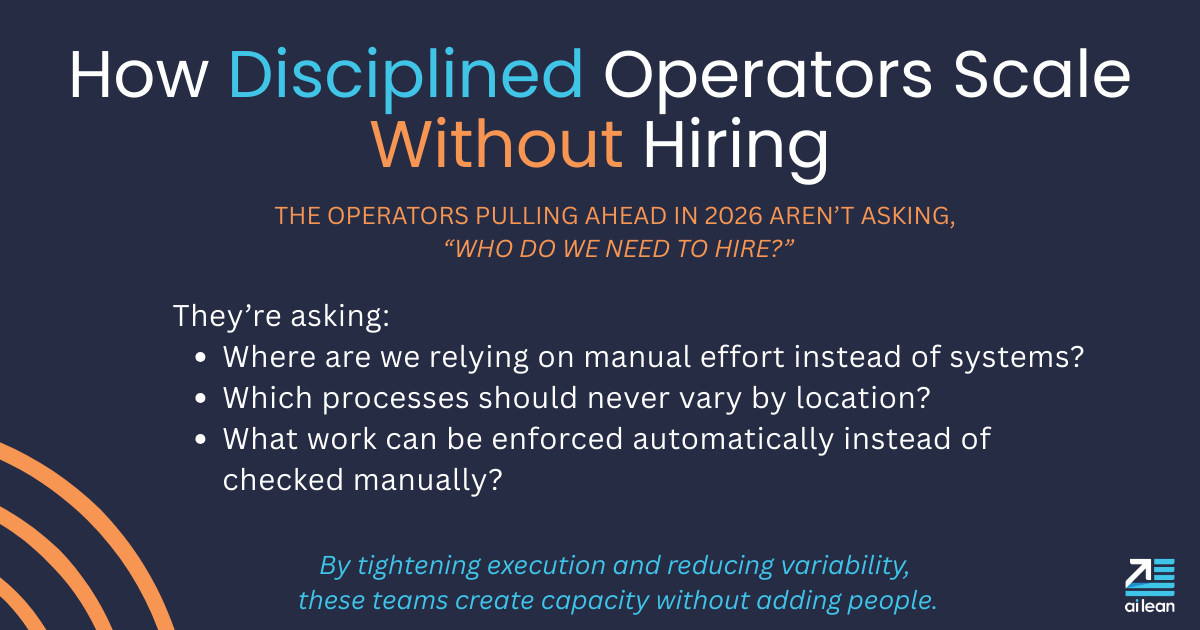
The operators pulling ahead in 2026 aren’t asking, “Who do we need to hire?”
They’re asking:
Where are we relying on manual effort instead of systems?
Which processes should never vary by location?
What work can be enforced automatically instead of checked manually?
By tightening execution and reducing variability, these teams create capacity without adding people.
Discipline becomes leverage.
What Operational Discipline Replaces
When discipline is embedded into systems, it replaces:
Manual tracking and reminders
Constant follow-ups and escalation
Reliance on hero employees
Firefighting near deadlines
Teams spend less time managing the work and more time completing it correctly the first time.
This is why disciplined operations feel calmer — even as portfolios grow.
How the Right Automation Extends Teams (Without Burning Them Out)
Hiring scales linearly. Automation doesn’t.
The right automation, designed around operational discipline, allows operators to:
Enforce timelines consistently across locations
Apply rules the same way every time
Surface exceptions early, before they require escalation
Reduce dependence on memory and manual oversight
Instead of adding people to catch problems, disciplined automation prevents many problems from occurring at all.
This isn’t about replacing staff. It’s about protecting them.
If adding headcount feels like the only way to keep up, there’s another option.
We offer a short walkthrough showing how disciplined automation helps operators scale portfolios without scaling payroll or burnout.
Book a demo to see how Ai Lean helps teams extend capacity through operational discipline
The Takeaway
In 2026, growth doesn’t come from hiring faster.
It comes from executing better.
Operators who invest in operational discipline gain scalability, predictability, and margin protection… without asking their teams to do more with less.
Identify Your Holes & Opportunities!

Is Your Collections & Delinquency Process Costing You?
Our new Collections & Delinquency Process Audit helps you quickly assess the strength of your current process, from early detection all the way through auction.
FAQ
Q: Why is operational discipline more important than hiring in 2026?
Operational discipline ensures consistent execution across locations without increasing overhead. As labor costs rise and margins tighten, disciplined systems reduce variability, prevent errors, and create scalable capacity without expanding payroll.
Q: Does this mean self-storage operators should stop hiring?
No. Hiring still plays a role in growth. However, adding headcount should not be the default solution to operational strain. Strengthening systems and processes first often creates capacity without increasing fixed labor costs.
Q: How does operational discipline improve margin?
Operational discipline reduces manual rework, prevents missed timelines, enforces compliance, and minimizes inconsistency. These improvements protect NOI by lowering labor drag and reducing risk-related costs.
Q: What causes inconsistency across storage portfolios?
Common causes include manual processes, location-specific workarounds, undocumented procedures, reliance on individual knowledge, and inconsistent enforcement of timelines.
Q: How does automation support operational discipline?
Disciplined automation enforces rules consistently, surfaces exceptions early, applies timelines uniformly, and reduces reliance on memory or manual oversight. It extends team capacity without increasing burnout.
Q: What is the risk of scaling through headcount alone?
Scaling through hiring alone increases payroll, training burden, management complexity, and execution variability. Over time, this erodes margin and creates operational fragility.
Sources & References
Self Storage Association — Industry Research
https://www.selfstorage.org/industry-research/McKinsey & Company — Operational Excellence & Productivity
https://www.mckinsey.com/business-functions/operations/our-insightsHarvard Business Review — The Costs of Organizational Complexity
https://hbr.org/2017/07/why-complexity-is-the-enemy-of-execution
Operational Discipline Series
Operational Discipline Is the New Growth Strategy
From Pandemic Playbook to Post-Boom Reality: Why Old Systems Are Failing Operators Now
3 System Signals That Are Quietly Limiting Performance
Why “Doing More” Is Hurting Self-Storage Operations in 2026
When More Oversight Slows Execution
The Cost of Fragmentation: How Disconnected Systems Quietly Erode Margin
How Manual Workarounds Quietly Erode Operational Discipline
Why Operational Discipline Beats Headcount in 2026
Operational Discipline Is Becoming the New Competitive Advantage in Self-Storage (wrap up)
Continue Reading